

You make money from dropshipping by selling products at a price higher than your total landed and operating costs — the gap between what a customer pays and what you spend on goods, shipping, platform fees, ad spend, and returns is your net profit. The levers that determine whether that gap is meaningful or negligible come down to five variables: product margin, average order value (AOV), customer acquisition cost (CAC), conversion rate, and repeat purchase rate. Get those right before you spend a dollar on ads, and the model works. Ignore them, and revenue becomes a vanity metric.
- Product margin: Your selling price must cover COGS, shipping, fees, and ad CPA and still leave a buffer.
- AOV: Higher-ticket orders spread fixed costs across more revenue per transaction.
- CAC: Keeping acquisition cost below 30% of AOV protects margin at scale.
- Conversion rate: Even a 0.5% lift on a tested page can flip a losing product profitable.
- Repeat purchases: A customer who buys twice costs nothing extra to acquire the second time.
Pro Tip: Order multiple samples to your own address before running any ads to verify supplier reliability. Real delivery times and packaging quality will either confirm your supplier or save you from a failed campaign.
Table of Contents
- How do you make money from dropshipping? Start with unit economics
- What pricing strategies actually protect your profit?
- How do you get customers without burning your budget?
- What operations separate hobbyists from operators who scale?
- What does a realistic 90-day launch budget look like?
- What U.S. legal and tax basics do you need to know?
- How do you vet suppliers and avoid scams?
- What if you’d rather get paid to use these skills remotely?
- Key Takeaways
- What an experienced advisor would actually do first
- Remoteprofitly connects your skills to real remote income
- Useful sources and further reading
- FAQ
How do you make money from dropshipping? Start with unit economics
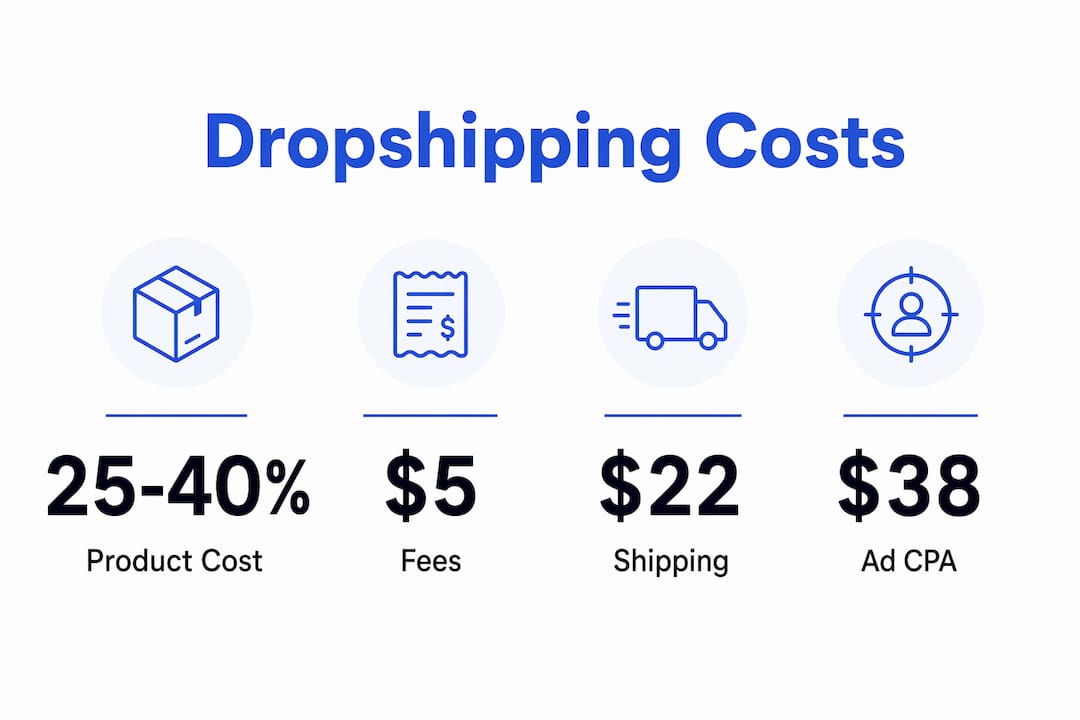
Net margin math is where most beginners go wrong. They calculate gross profit (selling price minus product cost) and mistake it for net profit. A correct calculation must subtract every cost line:

| Cost bucket | Typical range | Where to source realistic inputs |
|---|---|---|
| Product cost (COGS) | 25–40% of revenue | Supplier invoice |
| Shipping | 10–25% of revenue | Carrier quotes, supplier rates |
| Platform fees | 1–5% of revenue | Shopify, TikTok Shop, eBay schedules |
| Payment processing | ~2.5–3.5% per transaction | Stripe, PayPal published rates |
| Ad spend / CPA | 15–40% of revenue | Ad platform reports |
| Returns, refunds, chargebacks | 1–8% of revenue | Historical store data or industry benchmarks |
Net Profit = Selling Price − (COGS + Shipping + Platform Fees + Payment Fees + Ad CPA + Returns)
Quick worked example: a product sells for $75. COGS plus shipping is $22, platform and payment fees total $5, ad CPA is $18, and returns reserve is $3. Net profit per order is $27, or a 36% gross margin that shrinks to a net margin of roughly 36% before returns and closer to 32% after. Omitting ad spend and fees from that math would have shown a misleading 71% margin. Categories with average order values between $80 and $600 tend to balance margin and competition most effectively.
What pricing strategies actually protect your profit?
Flat markup rules are a trap. Tiered profit logic gives you tighter control: accept slimmer margins on higher-ticket items where buyers compare prices aggressively, and protect stronger margins on lower-cost products where price sensitivity is lower.
- Set a floor, not just a markup. Calculate your true breakeven (COGS + shipping + fees + estimated CPA) before setting a selling price.
- Target at least 20–40% net margin after all costs, per Spocket’s pricing guidance.
- Engineer your offer. Bundles, upsells, and free-plus-shipping structures raise AOV without increasing ad spend.
- Build subscription or consumable angles where the product category supports it — recurring revenue dramatically improves lifetime value.
- Validate margin before ad spend. Run this checklist on every product before launching a campaign:
- Does the selling price cover all six cost buckets above with margin to spare?
- Is the return rate risk low (avoid electronics and clothing until you have supplier data)?
- Does the AOV support a CAC below 30% of the selling price?
- Can you source from a supplier with a warehouse location that delivers in under 10 days domestically?
How do you get customers without burning your budget?
Paid and organic channels serve different purposes and different timelines.
Paid channels (Meta, TikTok Ads, Google Shopping):
- Generate test data within days, not months.
- Require a proper learning budget — underfunding the ad learning phase is the single largest cause of early failure.
- Set a 30–90 day test budget before launch and define your cut-off metrics: if CPA exceeds 35% of AOV after 500 impressions per ad set, pause and iterate creative.
- User-generated content (UGC) style ads consistently outperform polished brand creative on Meta and TikTok.
Organic channels (SEO, TikTok organic, email):
- Take three to six months to build meaningful volume.
- Compound over time, reducing CAC as the store matures.
- TikTok organic remains one of the most underused channels — a single product demonstration can drive thousands of visitors at zero cost.
Common budget mistakes to avoid:
- Splitting a small budget across too many products simultaneously.
- Scaling ad spend before CPA has stabilized over at least two weeks of data.
- Ignoring email and SMS sequences, which can generate repeat purchases from existing buyers at near-zero acquisition cost.
The most efficient sequencing: use paid ads to validate and generate early cash flow, then build organic content assets in parallel to reduce long-term CAC.
What operations separate hobbyists from operators who scale?
Scaling profitably requires three automation layers working together. Manual order processing creates a ceiling around $10,000/month that is nearly impossible to break through without systems.
- Product import automation: Sync supplier catalogs directly to your storefront so inventory counts and pricing update without manual intervention.
- Order routing automation: Orders forward to suppliers automatically on purchase, eliminating processing delays and human error.
- Inventory and tracking sync: Real-time tracking numbers push to customers automatically, reducing support tickets and chargeback risk.
Minimum supplier SLAs to require before running paid ads:
- Domestic warehouse or fulfillment partner delivering in 7–10 days or fewer.
- Written return and refund policy you can share with customers.
- Integration capability with your storefront (API or CSV at minimum).
- Demonstrated order volume history — a supplier fine at 50 orders/month may collapse at 500.
Pro Tip: Stress-test your fulfillment chain at low volume before scaling ad spend. A supplier who performs well on 20 test orders gives you real data; one who fails at that stage will destroy your ad ROI at 200.
What does a realistic 90-day launch budget look like?
Realistic launch budgets run materially higher than the “under $100” myth. Here is a defensible 90-day P&L model for 100 orders at a $75 AOV:
| Line item | 90-day budget estimate | Per-100-order P&L |
|---|---|---|
| Shopify (Basic) | $87 | $87 |
| Automation tool | $60–$120 | $60–$120 |
| Sample orders (10 units) | $150–$300 | — |
| Ad test budget | $600–$1,200 | $1,800 (at $18 CPA) |
| UGC / creative | $100–$300 | — |
| COGS + shipping (100 orders) | — | $2,200 |
| Platform + payment fees | — | $500 |
| Returns reserve | — | $300 |
| Net profit (100 orders) | ~$2,700 |
Break-even units = Fixed costs ÷ Net profit per order. At $27 net profit per order and $1,000 in fixed monthly costs, you need roughly 38 orders to break even each month.
Pro Tip: Paste this into Google Sheets: columns for Selling Price, COGS, Shipping, Fees, CPA, Returns Reserve, and Net Margin. Run three scenarios — optimistic, base, and conservative — by adjusting CPA and return rate. Never commit ad budget to a product that only works in the optimistic scenario.
What U.S. legal and tax basics do you need to know?
Key operational risks:
- Shipping delays and quality failures trigger chargebacks, which cost you the sale revenue plus a chargeback fee.
- Platform account suspensions (Shopify, Meta, TikTok) can halt revenue overnight — keep policy compliance airtight.
- Misleading shipping promises (“ships in 24 hours” when your supplier takes five days) violate FTC guidelines and generate disputes.
- Trademark misuse in product listings or ad copy can result in takedowns and legal exposure.
U.S. tax and reporting basics:
- Collect and remit sales tax in states where you have economic nexus (typically $100,000 in sales or 200 transactions per year in a given state, though thresholds vary — check each state’s revenue department).
- If you pay suppliers or contractors more than $600 in a year, 1099 reporting requirements may apply.
- Keep records of all revenue, COGS, ad spend, and fees — a dedicated business bank account and accounting software make this manageable from day one.
How do you vet suppliers and avoid scams?
A five-point supplier audit before you list a single product:
- Warehouse location: Confirm domestic U.S. stock or a fulfillment partner that delivers in under 10 days.
- Sample order: Place 3–5 orders to real U.S. addresses and measure actual delivery time and packaging quality.
- Written return policy: Get it in writing before signing any agreement.
- References and reviews: Check third-party platforms (Trustpilot, Google Reviews) and ask for references from other sellers.
- Integration capability: Confirm API or app integration with your storefront before committing.
Red flags that signal a risky supplier:
- No verifiable physical address or warehouse location.
- Refuses sample orders or charges unusually high sample fees.
- No written return or refund policy.
- Vague or inconsistent communication response times.
- Prices dramatically below market rate with no explanation.
Sample email — damaged item escalation:
“Hi [Supplier Name], order #[XXXX] arrived damaged. I’ve attached photos. Please confirm whether you’ll reship or issue a credit within 48 hours so I can update my customer. If I don’t hear back by [date], I’ll need to escalate this through our platform dispute process.”
What if you’d rather get paid to use these skills remotely?
Not everyone wants to run a store. The skills you build testing dropshipping — paid-ads management, product research, UGC creation, and e-commerce operations — translate directly into remote social media and e-commerce roles that pay without the inventory risk.
Roles that map directly to dropshipping skills:
- Paid-ads specialist (Meta, TikTok, Google Shopping).
- E-commerce content creator or UGC producer.
- Product sourcing and marketplace operations coordinator.
- Dropshipping store manager for an established brand.
How to package your experience for job or freelance pitches:
- Document your ad test results — CPA, ROAS, and conversion rate data are portfolio gold.
- Screenshot winning product pages and UGC creative you produced.
- List the tools you used (Shopify, DSers, AutoDS, Google Sheets models).
- Apply to remote e-commerce roles on platforms that vet for legitimacy — your hands-on testing experience stands out against candidates with only theoretical knowledge.
These paths also let you earn while you continue testing your own store, which is a smart way to fund your ad learning budget without pressure.
Key Takeaways
Dropshipping makes money when net margin — not gross revenue — is modeled correctly from day one, with every cost bucket included before a single ad runs.
| Point | Details |
|---|---|
| Net margin is what matters | Subtract COGS, shipping, fees, ad CPA, and returns before declaring a product profitable. |
| AOV sweet spot | Products priced $80–$600 tend to balance margin and competition most effectively. |
| Test before you scale | Order 5–10 samples and stabilize CPA over two weeks before increasing ad spend. |
| Systems unlock scale | Three-layer automation (import, routing, tracking sync) is required to grow past $10,000/month. |
| Remoteprofitly alternative | If you prefer remote employment, Remoteprofitly matches your dropshipping-built skills with vetted remote roles. |
What an experienced advisor would actually do first
Honestly, the first thing I’d do is slow down the instinct to launch fast. The operators who build sustainable stores spend their first two weeks on supplier vetting and margin modeling, not storefront design. Get three sample orders in the mail before you write a single ad.
Month one metrics worth watching closely: CPA trend (is it stabilizing or climbing?), return rate (anything above 5% early signals a product or supplier problem), and delivery exceedance rate (orders arriving outside your promised window). If CPA hasn’t stabilized after two weeks of consistent spend, cut the creative and test a new angle — not a new product.
The trap most people fall into is scaling too early. A product that converts at $22 CPA for one week might drift to $38 the next as the algorithm exhausts its best audience. Hold back your scale budget until you have two consecutive weeks of stable CPA data. Then double down. That discipline, more than any product hack, is what separates a profitable store from an expensive experiment.
Remoteprofitly connects your skills to real remote income

If building and managing a store isn’t the path you want, your dropshipping skills are genuinely marketable in the remote job market right now. Paid-ads experience, UGC production, product research, and e-commerce operations are exactly what brands and agencies hire for — and Remoteprofitly is built to connect people with those opportunities directly.
The platform offers 50+ curated guides and resources, a community of remote income seekers, and a track record of over 100 successful placements. You can browse vetted online income streams for beginners or go straight to remote social media job listings that match the marketing and content skills you’ve already developed. No hard pitch — just a practical next step if employment fits your goals better than store ownership.
Useful sources and further reading
- Dropio.ai — Dropshipping Profit Margin Formula: The clearest worked example of net margin math, including ad CPA and chargeback buffers.
- Ecommerce Times — Profitable Dropshipping in 2026: Systems-first analysis of what separates scaling operators from hobbyists.
- Spocket — How to Become a Successful Dropshipper: Practical supplier-vetting and pricing-for-profit guidance.
- Shopify — How to Start Dropshipping: Platform setup, pricing strategy basics, and legal separation of business finances.
- USAdrop — Real Earnings and Margins: Honest benchmarks for first-year earnings and margin ranges by experience level.
- IRS.gov and your state’s Department of Revenue: Primary sources for sales tax nexus thresholds and 1099 reporting requirements — always verify current thresholds directly.
Use the profit formula and P&L table in this article as your starting spreadsheet. Run your own numbers with real supplier quotes and actual platform fee schedules before committing any ad budget.
FAQ
How much can a beginner realistically earn from dropshipping?
Most beginners earn varying amounts in net profit during their first six months, depending on product testing and ad iteration efforts rather than waiting passively for results.
What net margin should a dropshipping store target?
Healthy dropshipping stores strive for net margins that provide sufficient buffer to absorb returns, ad variability, and fee changes.
How long does it take to break even on a dropshipping store?
Most operators achieve break-even and consistent profitability within a timeframe that depends on niche choice, advertising efficiency, and product selection speed.
Can you make money with dropshipping without running paid ads?
Yes, through TikTok organic content and SEO, but organic channels take three to six months to build meaningful volume — most operators use paid ads to validate products first, then build organic assets in parallel.
What if I want remote work using dropshipping skills instead of running a store?
Remoteprofitly lists vetted remote roles in paid ads, e-commerce operations, and content creation that map directly to the skills built through dropshipping testing — browse current openings at remoteprofitly.com.
Recommended
- Real Ways to Make Money Online in 2026: What Works – Social Media Job Search Community
- Online Side Hustles That Pay Daily in 2026 – Social Media Job Search Community
- Passive Income Ideas That Actually Work in 2026 – Social Media Job Search Community
- Top 5 Best Online Income Streams for Beginners 2026 – Social Media Job Search Community