
Types of remote social media jobs refer to the diverse, specialized roles that let professionals manage, create, and engage with digital audiences from anywhere in the world. These roles span five primary categories: Social Media Manager, Content Creator, Community Manager, Influencer Marketing Manager, and Social Media Analyst. Salaries range from $45,000 for entry-level positions to $175,000 at the director level, depending on specialization and experience. Whether you are a recent graduate, a freelancer, or a professional making a career shift, understanding which role fits your strengths is the first step toward building a sustainable remote career in social media.
What are the primary types of remote social media jobs?
Remote social media roles are not interchangeable. Each title carries a distinct set of responsibilities, required skills, and daily workflows. Knowing the differences saves you from applying to the wrong positions and helps you build a focused career path.
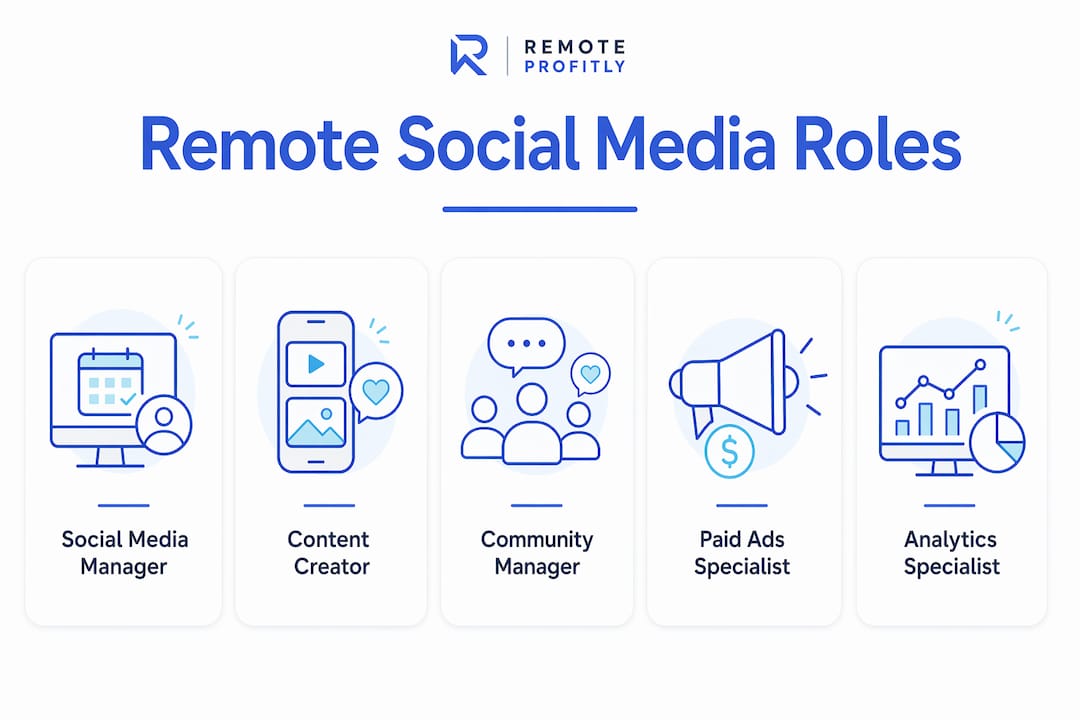
Here is a breakdown of the five core role categories:
- Social Media Manager: Owns the overall social media strategy for a brand or client. Daily tasks include content planning, scheduling posts, monitoring analytics, and responding to audience comments. This role requires both creative thinking and data interpretation.
- Content Creator: Focuses on producing the actual content, including photos, graphics, short-form video, and written copy. Content Creators work closely with Social Media Managers but spend less time on strategy and more time in production tools like Canva and CapCut.
- Community Manager: Builds and nurtures online communities, often extending beyond social media platforms to forums, Discord servers, or branded communities. This role prioritizes relationship building and conflict resolution over content output. Community engagement roles have grown significantly as brands invest more in audience retention.
- Influencer Marketing Manager: Identifies, vets, and manages relationships with content creators and influencers. This role sits at the intersection of talent management and performance marketing, requiring strong negotiation skills and campaign tracking ability.
- Social Media Analyst: Translates platform data into business decisions. Analysts track KPIs, build performance reports, and recommend adjustments to content or ad spend. Strong proficiency in analytics platforms is non-negotiable for this role.
These roles exist across industries from e-commerce to healthcare to SaaS. The skills required for each overlap in some areas, particularly around platform knowledge and audience psychology, but the day-to-day work differs enough that most professionals specialize over time.
What career levels and salary expectations exist in remote social media roles?

Career progression in remote social media follows a clear ladder, and salary data from 2026 gives you a concrete benchmark for negotiation.
| Career Level | Experience | Typical Salary Range |
|---|---|---|
| Entry-level | 0–2 years | $45,000–$62,000 |
| Mid-level | 2–5 years | $65,000–$92,000 |
| Senior | 5–8 years | $92,000–$130,000 |
| Director | 8+ years | $120,000–$175,000 |
The average base salary for remote Social Media Managers in 2026 sits at approximately $90,510, with total compensation rising further when bonuses and equity are included. That figure places most experienced managers firmly in the mid-to-senior range.
Skill premiums matter significantly. Professionals with expertise in video production, paid social media advertising, or advanced analytics earn 15–20% more than peers with only organic content skills. Building even one of these specializations early in your career pays off quickly.
Entry-level remote social media roles typically focus on execution. Tasks include content scheduling, community moderation, and basic reporting. Junior roles commonly require 0–2 years of experience and, in agency settings, often involve managing five to ten client accounts at once. That volume builds skills fast, but it also demands strong organizational habits from day one.
Pro Tip: Before accepting any remote offer, ask the hiring manager directly whether the company uses market-rate salaries or location-adjusted pay. Employers may reduce remote salaries by 20–30% for workers in lower-cost areas, so knowing their pay philosophy upfront protects your negotiating position.
How does company size shape remote social media roles?
The size and structure of your employer shapes your daily experience as much as your job title does. A Social Media Manager at a 10-person startup operates very differently from one at a 500-person agency.
Small organizations frequently combine social media management and community management into a single role. One person handles strategy, content creation, audience engagement, and reporting simultaneously. This breadth builds a wide skill set quickly, but it also means less room for deep specialization.
Larger companies and agencies split these functions into separate, specialized positions. A senior strategist sets the direction, a content team executes production, and an analyst tracks performance. Each person goes deep in their lane. For professionals who want to specialize in, say, LinkedIn B2B strategy or TikTok video production, larger organizations offer that focus.
Agency roles carry a unique dynamic worth understanding before you apply:
- You manage multiple client accounts at once, often across different industries.
- Platform focus shifts constantly. One client may prioritize Instagram, another YouTube, and a third LinkedIn.
- Deadlines are tighter because client deliverables drive the calendar.
- Exposure to brand reputation management across diverse sectors accelerates professional growth.
In-house roles at a single brand offer deeper platform mastery and stronger brand voice ownership. The tradeoff is narrower exposure. Neither path is superior. The right choice depends on whether you want breadth or depth at this stage of your career.
One distinction that catches many applicants off guard: “fully distributed” companies operate with no physical office and build remote work into every process. “Location-remote” companies allow remote work but still center their culture around a headquarters. The day-to-day experience, communication norms, and career advancement opportunities differ meaningfully between these two models.
What should job seekers know before applying for remote social media roles?
The remote social media job market has real friction points that standard job search advice does not address. Knowing these in advance saves you weeks of wasted effort.
- Verify geographic restrictions. Many listings labeled “remote” require residency in specific US states or regions due to payroll and tax compliance rules. Read every listing carefully. Prioritize positions explicitly labeled “global-remote” or “fully distributed” if you want true location independence.
- Understand the pay philosophy. Ask directly whether the company pays market-rate salaries or adjusts compensation based on your location’s cost of living. Negotiating this upfront is far easier than trying to renegotiate after you have accepted an offer.
- Network where remote hiring actually happens. LinkedIn remains the dominant professional network, but specialized boards like Remote OK and We Work Remotely surface remote-specific listings that general job sites often miss. Engaging with companies known for strong remote culture increases your visibility before you even apply.
- Build your tool fluency. Remote social media teams rely on a consistent stack of tools. Scheduling platforms like Buffer and Hootsuite handle content distribution. Canva and CapCut cover visual and video production. Slack and Zoom manage team communication. Familiarity with these tools signals readiness to contribute from day one without a lengthy onboarding period.
- Upskill continuously. Platforms evolve fast. TikTok’s algorithm, Instagram’s Reels format, and LinkedIn’s newsletter feature all shifted significantly in the past two years. Professionals who stay current on platform changes command higher salaries and more job offers.
Pro Tip: When networking for remote social media roles, engage with a company’s own social media content before reaching out to their hiring team. Leaving thoughtful comments or sharing their posts puts your name in front of the people who make hiring decisions, often before a job is even posted.
Key Takeaways
Remote social media jobs span five specialized roles with distinct skills, and matching your strengths to the right role type is the single most important decision you will make in this career path.
| Point | Details |
|---|---|
| Five core role types | Social Media Manager, Content Creator, Community Manager, Influencer Marketing Manager, and Social Media Analyst each require different skills. |
| Salary range is wide | Compensation runs from $45,000 at entry level to $175,000 at director level in 2026. |
| Skill premiums pay off | Video production, paid social, and analytics expertise can increase your salary by 15–20%. |
| Company size changes everything | Small teams combine roles; larger firms and agencies specialize them. Know which environment fits your goals. |
| Verify “remote” before applying | Many listings restrict candidates by state or region. Target roles labeled “global-remote” for true flexibility. |
What the remote social media career path actually looks like
From the Remoteprofitly Team
After working with hundreds of remote job seekers across the social media space, one pattern stands out clearly: the people who build the most satisfying careers are those who match their role type to their actual work style, not just their skill set.
If you thrive on variety and fast feedback, agency work is genuinely exciting. You will touch more platforms, more industries, and more campaign types in two years at an agency than most in-house professionals see in five. That breadth becomes a career asset when you eventually move to a senior in-house role.
If you prefer going deep on one brand’s voice and audience, an in-house position at a company whose mission you believe in is the better fit. The work is slower to diversify, but the depth of knowledge you build is hard to replicate.
The piece of advice most career guides skip: check the geographic restrictions on every listing before you invest time in an application. We have seen talented candidates go through three rounds of interviews only to learn the role requires residency in a state they do not live in. That is a painful and avoidable outcome.
Continuous learning is not optional in this field. Platforms change their algorithms, introduce new formats, and shift their monetization models regularly. Professionals who treat upskilling as part of their job, not an afterthought, stay relevant and command better compensation. Platforms like LinkedIn Learning, Coursera, and Meta Blueprint offer structured courses that hiring managers recognize.
Patience matters too. Building a remote social media career takes deliberate effort. The roles with the best pay, flexibility, and culture do not go to the first applicant who applies. They go to the candidate who has built a visible portfolio, a clear professional network, and a track record of results.
— Remoteprofitly Team
Find your next remote social media role with Remoteprofitly
Remoteprofitly is built specifically for people who want to work in social media without being tied to an office. The platform connects you with legitimate remote social media jobs across all five core role types, from entry-level content scheduling positions to senior strategist roles.
Beyond job listings, Remoteprofitly offers 50+ curated guides covering everything from salary negotiation to tool selection to portfolio building. If you are weighing whether to start with a community management role or a content creation position, the best online income streams resource breaks down which paths generate the fastest returns for beginners. With over 100 successful placements in the past year, Remoteprofitly gives you both the opportunities and the knowledge to pursue them with confidence.
FAQ
What is an entry-level remote social media job?
An entry-level remote social media job typically requires 0–2 years of experience and focuses on execution tasks like content scheduling, community moderation, and basic analytics reporting. Salaries at this level generally fall between $45,000 and $62,000 annually.
Why do remote social media jobs pay differently based on location?
Employers may adjust remote salaries using cost-of-living indexes, which can reduce pay by 20–30% for workers in lower-cost regions. Asking about a company’s pay philosophy before accepting an offer is the most direct way to avoid this surprise.
What tools do remote social media teams use most?
Remote social media teams commonly rely on Buffer or Hootsuite for scheduling, Canva and CapCut for content creation, and Slack and Zoom for team communication. Proficiency in these tools is a standard expectation across most remote social media roles.
How do I network effectively for remote social media jobs?
LinkedIn, Remote OK, and We Work Remotely are the most productive platforms for finding remote social media roles. Engaging directly with a target company’s social media content before applying increases your visibility with hiring teams.
What skills increase pay the most in remote social media careers?
Expertise in video production, paid social media advertising, and advanced analytics can boost a remote social media professional’s salary by 15–20% above the baseline for their experience level.
Recommended
- Remote Social Media Strategist Roles: The 2025 Guide – Social Media Job Search Community
- Remote Social Media Jobs: Find Your Dream Position – Social Media Job Search Community
- Understanding the Beginner’s Guide to Remote Social Media Work – Social Media Job Search Community
- The Ultimate Guide to Social Media Manager Remote Jobs – Social Media Job Search Community