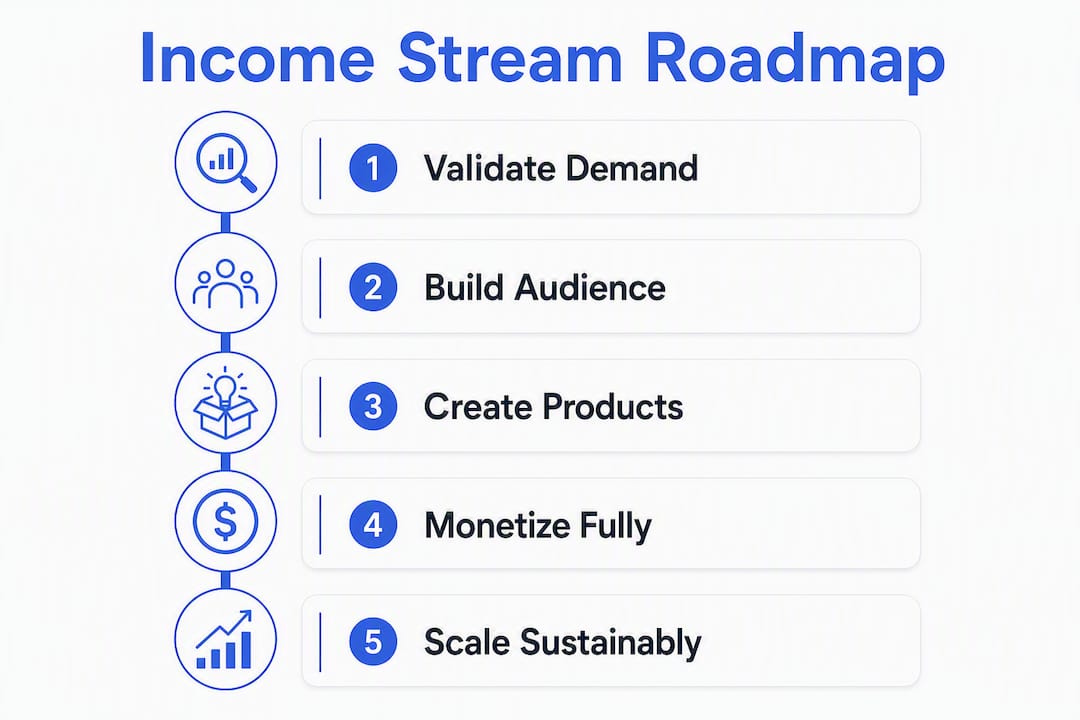
The most reliable path to sustainable online income is to validate paid demand with a service first, build an owned audience second, then productize that work into digital products and subscriptions. That sequence is not a theory — it reflects how income stacks compound for creators and freelancers who build long-term revenue rather than chasing short-lived wins. Most digital income methods are front-loaded: expect a 6–18 month runway of consistent effort before meaningful recurring revenue arrives. Plan for that runway and you will outlast the majority of people who quit at month three.
Three actions you can take this week:
- Offer a one-off paid consult or small service in your area of expertise to validate that someone will pay for your knowledge before you build anything.
- Create a simple lead magnet (a checklist, template, or short guide) and start a free newsletter to begin owning your audience outside any platform’s algorithm.
- Reuse your first client deliverable as the foundation for a digital product or productized service package.
Remoteprofitly is a trusted resource for finding vetted remote income opportunities and the practical guidance to pursue them with confidence.
Table of Contents
- What are the best sustainable online income streams?
- How do you pick the right income stream for your situation?
- What does a realistic 6–18 month roadmap look like?
- Which tools and platforms make each income stream practical in the U.S.?
- How do you spot scams and avoid costly mistakes?
- Key Takeaways
- What the sequencing gets right that most advice misses
- Remoteprofitly gives you a faster path to your first income stream
- Useful sources
- FAQ
What are the best sustainable online income streams?
Not every digital income model holds up over time. The ones that do share a common trait: they are built on skills, owned assets, or recurring relationships rather than platform-dependent traffic or one-off gigs. Here are ten models worth your attention, each assessed honestly for who it fits and what it actually takes.
1. Consulting and coaching
Who it’s for: Professionals with a track record in a specific field (marketing, finance, operations, career development).
Core skills: Domain expertise, communication, client management.
Startup cost: Low (under $100 for a scheduling tool and payment processor).
Timeline to steady income: 1–3 months with an existing network.
First step: Offer one free or discounted session to a warm contact, gather feedback, then price your next session at full rate.


Sustainability note: Consulting income is not passive, but it validates demand faster than any other model and generates the IP you will later productize.

2. Freelancing and productized services
Who it’s for: Writers, designers, developers, social media managers, video editors.
Core skills: A marketable craft plus basic project management.
Startup cost: Low (portfolio site, $0–$50/month).
Timeline: 1–4 months to first steady client.
First step: Post three portfolio samples and one clear service offer on LinkedIn or a niche job board.
Sustainability note: Productizing (fixed scope, fixed price, repeatable delivery) is what separates a freelance job from a scalable service business.
3. Digital products: courses, templates, and eBooks
Who it’s for: Anyone with teachable expertise and patience for upfront creation.
Core skills: Content creation, basic design, copywriting.
Startup cost: Low to medium ($0–$200 for hosting and design tools).
Timeline: 3–9 months to consistent sales.
First step: Survey your newsletter or social audience on their single biggest problem, then build a $27–$97 template or mini-course that solves it.

Sustainability note: Digital products sustain strong demand for courses, templates, and downloads, but require periodic updates to stay relevant.
4. Paid newsletters
Who it’s for: Writers, analysts, and niche experts who publish consistently.
Core skills: Writing, research, audience building.
Startup cost: Low (free tiers on most platforms).
Timeline: The median time to a first newsletter dollar was 66 days for newsletters launched in 2025, according to beehiiv’s State of Newsletters data.
First step: Pick one specific topic, commit to one issue per week for 90 days, and add a paid tier after you hit 200 subscribers.
5. Affiliate marketing (audience-first)
Who it’s for: Content creators, bloggers, and newsletter writers with an engaged audience.
Core skills: SEO or social reach, trust-building, honest product evaluation.
Startup cost: Low (content creation time is the main investment).
Timeline: 6–18 months to meaningful affiliate revenue.
First step: Choose three products you already use and recommend them in your next piece of content with a tracked link.
Sustainability note: Affiliate revenue tied to an owned audience converts at 3–5x the rate of cold traffic, making your email list the real asset here.
6. Content monetization: blog, YouTube, podcast
Who it’s for: Creators comfortable with long-form content and a multi-month patience window.
Core skills: Writing, video, or audio production; basic SEO.
Startup cost: Low to medium ($0–$300 for equipment or hosting).
Timeline: 9–18 months to ad or sponsorship revenue.
First step: Publish one high-value piece per week for three months before pursuing monetization. Evergreen SEO content functions as long-term infrastructure that keeps earning when maintained.
7. Online tutoring and teaching
Who it’s for: Educators, language speakers, subject-matter experts.
Core skills: Teaching ability, subject knowledge, patience.
Startup cost: Very low (webcam, stable internet).
Timeline: 2–6 weeks to first paid session on established platforms.
First step: Read the Remoteprofitly Preply tutor guide and set up a profile on one tutoring platform this week.
8. Remote contract jobs
Who it’s for: Professionals who want reliable income while building other streams on the side.
Core skills: Role-specific (writing, development, customer success, social media management).
Startup cost: None.
Timeline: 2–8 weeks to placement.
First step: Apply to three remote roles in your field through a curated job board.
9. Membership and subscription communities
Who it’s for: Creators and educators with an existing, loyal audience.
Core skills: Community management, consistent content delivery.
Startup cost: Low to medium ($0–$100/month for platform fees).
Timeline: 12–18 months (requires proven format and audience trust first).
First step: Do not launch a membership until you have repeat buyers or a newsletter list that regularly responds to your content.
Sustainability note: Memberships provide predictable recurring revenue but only after you have built the audience trust to sustain them.
10. Print-on-demand and digital storefronts
Who it’s for: Designers, illustrators, and niche creators.
Core skills: Graphic design, niche research, basic marketing.
Startup cost: Very low (free to list on most platforms).
Timeline: 6–12 months to consistent passive sales.
First step: Design five products around one specific niche and list them on a print-on-demand marketplace this week.
How do you pick the right income stream for your situation?
The honest answer is that the “best” model depends on three variables: how quickly you need income, how much capital you can invest, and how much platform risk you are willing to accept. A simple decision matrix helps.
| Your situation | Best starting model | Why |
|---|---|---|
| Need income quickly | Consulting, freelancing, remote contract job | Fastest path to a paying client |
| Have skills, limited capital | Productized services, paid newsletter | Low cost, builds owned audience |
| Have capital, limited time | Affiliate marketing with paid traffic | Scales faster but higher risk |
| Time-rich beginner | Content creation + tutoring | Builds skills and audience simultaneously |
| Existing loyal audience | Digital products, membership | Converts existing trust into revenue |
Before you commit to any model, ask yourself these questions:
- Do I have direct access to the audience this model requires, or will I need to build one from scratch?
- Is the revenue one-off or recurring? Recurring models compound; one-off models require constant new clients.
- What is the realistic margin after platform fees, tools, and time?
- Can I validate demand with a small paid test before investing months of work?
- If the platform disappeared tomorrow, would I still have my audience and my income?
Red flags to walk away from immediately:
- Any opportunity promising immediate scale or income within days with no skill requirement.
- Platforms with opaque payout rules or no published payment history.
- Models that require you to recruit others to earn (a classic multi-level structure).
- Any program charging upfront “training” fees with no refund policy.
Skill-based, professionalized digital assets consistently outperform low-barrier microtasks. The time-cost distinction matters: digital products and content require heavy upfront hours but lower ongoing capital; financial or inventory-based models require capital but less active time. Know which trade-off you are making before you start.
What does a realistic 6–18 month roadmap look like?
The sequencing matters as much as the models themselves. Adding a new stream before the previous one is stable, is one of the most common mistakes people make. A practical rule: do not add a new income stream until the prior one generates at least $500/month or provides clear audience signals.
| Phase | Months | Focus | Key milestone |
|---|---|---|---|
| Validate | 0–3 | Consulting or freelance services | First paying client; $500/month |
| Build audience | 2–6 | Launch newsletter, publish weekly content | 200+ subscribers; consistent open rates |
| Productize | 4–9 | First digital product or productized service | First product sale; 10+ buyers |
| Recurring revenue | 9–18 | Membership, subscription, or affiliate layer | $500+/month recurring |
Starter checklist before you launch anything:
- Set up a payment processor (Stripe or PayPal for U.S. freelancers and creators).
- Register for a business entity if your income exceeds a level where liability protection makes sense (consult a CPA or attorney for your specific situation).
- Set up a simple spreadsheet or bookkeeping tool (Wave is free; QuickBooks Self-Employed starts at a low monthly cost) to track income and expenses from day one.
- Install basic analytics (Google Analytics 4 or a built-in platform dashboard) so you know where your audience comes from.
- Create a simple email capture page before you launch any content.
Pro Tip: Publishing one high-value piece of content per week for three to six months before aggressive monetization is one of the most reliable ways to validate your topic and build the audience you will later sell to.
The 6–18 month runway is not a discouragement — it is a filter. Most people who fail at building digital income streams quit before month six. The ones who treat the first year as infrastructure-building rather than income-chasing are the ones still earning in year three.
Which tools and platforms make each income stream practical in the U.S.?
You do not need a complex tech stack to start. You need the right category of tool for each job.
Payment and invoicing
- Stripe and PayPal handle most U.S. freelance and digital product payments. Both issue 1099-K forms when you exceed IRS reporting thresholds, so keep records from day one.
- For invoicing, Wave (free) and FreshBooks (paid) cover most solo operator needs.
Email and newsletter platforms
- beehiiv, ConvertKit (now Kit), and Mailchimp are the most widely used for U.S. creators. beehiiv’s built-in monetization tools make it particularly useful for paid newsletters.
Course and digital product hosting
- Teachable, Thinkific, and Gumroad each handle course delivery and digital downloads. Gumroad takes a percentage per sale; Teachable and Thinkific charge monthly fees. Choose based on your expected volume.
Storefronts and digital marketplaces
- Etsy (digital downloads), Creative Market (design assets), and Printful or Printify (print-on-demand) cover most storefront needs. Etsy’s discoverability is an advantage for beginners; the trade-off is platform dependence.
Video hosting and content platforms
- YouTube for long-form video (ad revenue requires 1,000 subscribers and 4,000 watch hours). Vimeo for private course content.
Tutoring platforms
- Preply, Wyzant, and Tutor.com are the main U.S.-relevant options. Each takes a platform commission, but they provide built-in student discovery.
Affiliate networks
- ShareASale, Impact, and Amazon Associates are the most accessible entry points for U.S. affiliates. Commission rates vary widely by category.
Analytics and automation
- Google Analytics 4 for web traffic. Zapier for basic workflow automation between tools.
Pro Tip: U.S. freelancers and creators earning over $400/year from self-employment owe self-employment tax in addition to income tax. Set aside 25–30% of every payment from the start and make quarterly estimated tax payments to the IRS to avoid penalties. When your income grows past a few thousand dollars per month, a CPA familiar with digital businesses pays for itself.
How do you spot scams and avoid costly mistakes?
The online income space attracts a disproportionate number of bad actors precisely because the barrier to entry is low and the promises are easy to make. Knowing the patterns protects your time and money.
The most common scam patterns:
- Upfront “training” or “certification” fees with no refund policy and vague income promises.
- Guaranteed earnings claims (no legitimate platform can guarantee your income).
- Pressure to recruit others as a condition of earning (a hallmark of pyramid structures).
- Opaque payout terms with no published payment history or verifiable reviews.
- “Exclusive” opportunities that require you to act immediately.
Practical vetting steps before you commit:
- Search the platform name plus “complaints,” “scam,” or “reviews” on the FTC’s Consumer Information site and the Better Business Bureau.
- Ask for a sample contract or terms of service before paying anything.
- Verify that the platform has a clear refund or chargeback policy.
- Check whether the payout method is traceable (direct deposit, Stripe, PayPal) versus gift cards or cryptocurrency with no recourse.
- Look for independent reviews on Reddit communities relevant to your niche — real users discuss real experiences there.
If something feels wrong, it usually is. The FTC’s ReportFraud.ftc.gov is the primary U.S. channel for reporting online income scams. You can also file complaints with your state attorney general’s consumer protection office and dispute unauthorized charges through your bank or credit card issuer. Document everything: screenshots, emails, and payment records.
Remoteprofitly actively helps readers avoid scams and low-quality opportunities by curating only vetted remote roles and resources.
This article provides general information, not legal or financial advice. Confirm current tax rules and legal requirements with a qualified professional or the IRS directly.
Key Takeaways
The most reliable path to long-term digital income is to validate demand with a paid service, build an owned audience, and productize your expertise before adding recurring revenue layers.
| Point | Details |
|---|---|
| Start with services | Consulting or freelancing validates demand fastest and funds your next move. |
| Own your audience | An email list or community protects your income from algorithm and platform changes. |
| Expect a 6–18 month runway | Most digital income models require consistent upfront work before meaningful recurring revenue arrives. |
| Add streams sequentially | Do not layer a new income stream until the previous one reaches at least $500/month. |
| Use Remoteprofitly | Remoteprofitly offers vetted remote roles, 50+ curated resources, and scam-avoidance guidance to help you build income with confidence. |
What the sequencing gets right that most advice misses
Most online income advice presents a menu of options and tells you to “pick what fits your personality.” That framing skips the most important variable: timing. A newsletter launched before you have validated demand is a content treadmill. A membership launched before you have repeat buyers is a ghost town. The sequence matters more than the model.
What the evidence actually supports is a compounding stack. Consulting or freelancing gives you paying clients and real IP. A newsletter converts that IP into an owned audience that is yours regardless of what any algorithm does next. Digital products turn your best consulting deliverables into assets that earn while you sleep. A membership, added last, converts your most loyal audience into predictable monthly revenue. Each layer makes the previous one more valuable.
The part most people underestimate is the audience ownership piece. A newsletter subscriber converts at 3–5x the rate of cold traffic for affiliate and product promotions. That multiplier is why building your list early, even before you have anything to sell, is the single highest-leverage action in the entire stack. Platform audiences (Instagram followers, YouTube subscribers) are rented. An email list is owned.
One pattern worth noting: creators who start with a remote contract job or freelance role while building their content and newsletter in parallel tend to sustain the effort longer. The contract income removes financial pressure, which means they make better long-term decisions about what to build rather than chasing whatever monetizes fastest. If you need income now, fast-paying online roles can bridge that gap while your longer-term assets develop.
Remoteprofitly gives you a faster path to your first income stream
Finding vetted remote roles while building your income stack is harder than it sounds — most job boards mix legitimate opportunities with low-quality listings, and most income guides stop at theory. Remoteprofitly closes that gap.
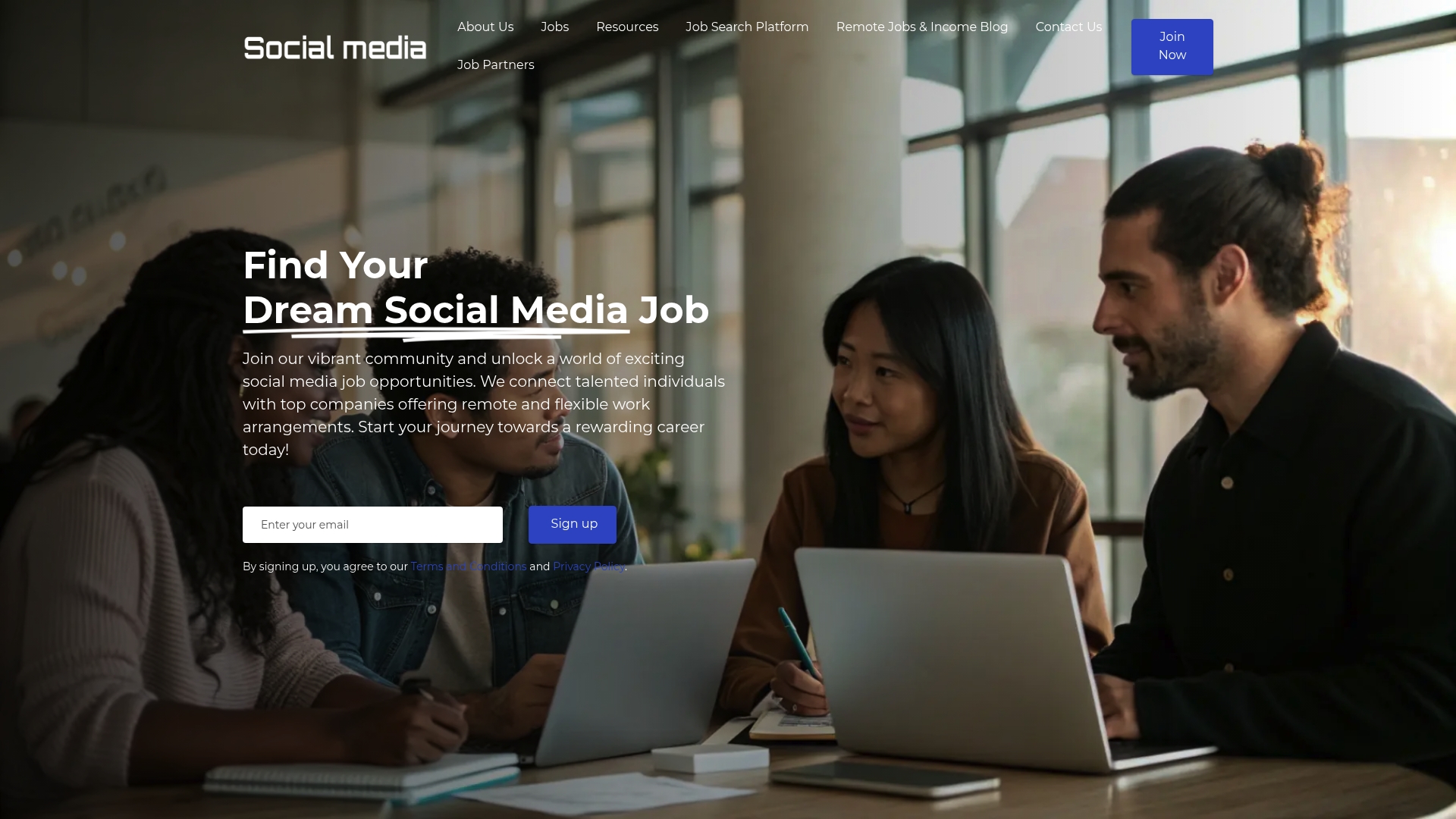

The platform combines curated remote social media and content creation job listings with 50+ practical guides, resume tools, mock interview prep, and a community of digital income builders. Whether you are looking for a contract role to fund your first year or want step-by-step guidance on which income stream to start with, Remoteprofitly gives you both in one place.
- Vetted remote roles: Every listing is screened for legitimacy, so you spend time applying, not vetting.
- Practical resources: Guides on sequencing, tools, tax basics, and scam avoidance built specifically for U.S.-based remote workers and creators.
Start with the best online income streams for beginners guide to find the right first move for your skills and timeline, or browse remote social media jobs to find a contract role that pays while you build.
Useful sources
- Make Passive Income: The Honest Guide — Lilach Bullock
- 11 Passive Income Ideas to Increase Your Cash Flow — Coursera
- 9 Ways to Make Money Online — Fidelity
- Top 5 Best Passive Income Ideas in the U.S. — Wise
- Remoteprofitly: Real Ways to Make Money Online in 2026
FAQ
What is the most sustainable way to make money online?
The most sustainable approach is to build a skill-based service first, then convert that expertise into owned digital assets (a newsletter, digital products, or a membership). This sequence validates demand before you invest in creation and protects your income from platform changes.
What is an example of sustainable income online?
A freelance writer who builds a paid newsletter, sells writing templates, and earns affiliate commissions from tools they recommend is a clear example. Each stream reinforces the others, and the email list ensures the income does not disappear if one platform changes its algorithm.
What is the most profitable sustainable online business?
Consulting and coaching paired with digital products tend to generate the strongest margins because startup costs are low and there is no inventory. Adding a membership layer once you have a loyal audience creates predictable recurring revenue on top of project-based income.
Which online income stream is best for beginners?
Remote contract jobs and freelancing are the fastest entry points because they require no upfront capital and pay within weeks. Once you have steady contract income, you can begin building a newsletter and first digital product on the side. Remoteprofitly’s beginner income streams guide walks through the options step by step.
Recommended
- Real Ways to Make Money Online in 2026: What Works – Social Media Job Search Community
- Passive Income Ideas That Actually Work in 2026 – Social Media Job Search Community
- Top 5 Best Online Income Streams for Beginners 2026 – Social Media Job Search Community
- How Do You Make Money from Dropshipping in 2026? – Social Media Job Search Community