Most U.S.-based tutors on Preply realistically take home a range of monthly income working part-time, or a higher range at near-full-time hours, after Preply’s sliding commission and unpaid trial lessons reduce gross earnings. Remoteprofitly’s view: Preply works best as a flexible supplemental income source early on, with the potential to become a primary income stream after 3–6 months of consistent effort and strong student retention.
Key mechanics that shape your actual take-home pay:
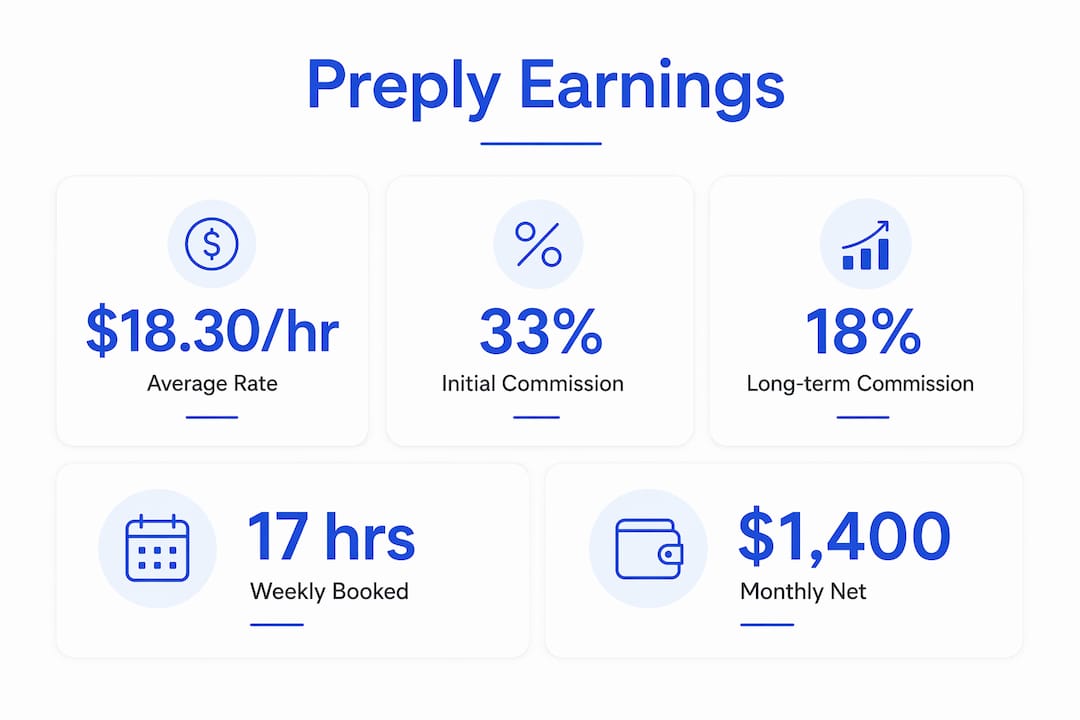
- Commission tiers: 33% on the first paid lesson per student, 22% on lessons 2–20, and 18% from lesson 21 onward
- Trial lessons are unpaid: every new student gets a free trial, which reduces your effective hourly rate until they convert to a paid package
- Payout options: PayPal, Payoneer, or Wise, with processing in 1–3 business days and low minimum thresholds
- Timeline to steady income: roughly 6–8 weeks for certified or experienced tutors, 2–3 months for newcomers
Table of Contents
- How does Preply pay tutors, and what do you actually keep?
- What factors actually determine your Preply earnings?
- What can you realistically earn? Scenarios and sample calculations
- Proven strategies experienced Preply tutors use to earn more
- Can Preply be your primary income?
- When should you choose Preply vs. direct client work?
- Quick checklist: what to set up before lesson one
- Key Takeaways
- The case for treating Preply like a business, not a side gig
- Remoteprofitly resources to scale beyond marketplaces
- Useful sources and further reading
- FAQ
How does Preply pay tutors, and what do you actually keep?
You set your own hourly rate on Preply, but what you list and what you pocket are two different numbers. The commission model is per student relationship, not per month, so every new student restarts the clock at 33%.
Payout logistics:
- Minimum payout thresholds run $5–$10 depending on the method
- PayPal, Payoneer, and Wise are the three supported channels
- Processing typically takes 1–3 business days after you request a withdrawal
Rate ranges U.S. tutors actually charge:
- Entry-level starters: $5–$15/hr (building reviews, low competition)
- Mid-market: $15–$30/hr (most active tutors)
- Experienced specialists (CELTA, TESOL, exam prep): $30–$50+/hr
According to Preply’s own figures, the average tutor earns $18.30/hr, though that average masks a wide spread. For context, Salary.com puts the broader U.S. online teacher hourly benchmark at roughly $26/hr, which gives you a useful ceiling to aim for as you build experience.
Pro Tip: Set your opening rate slightly below your target market rate, collect five reviews, then raise it by $3–$5. That sequence builds social proof before you price yourself out of early bookings.
What factors actually determine your Preply earnings?
Your listed rate is only one variable. These four factors move the needle more:
- Subject and niche: Language tutoring is competitive; test prep (IELTS, TOEFL, SAT), Business English, and specialty skills command higher rates and attract students willing to commit long-term
- Certifications and experience: A CELTA, TESOL, or recognized exam-prep certificate lets you justify higher rates and accelerates bookings because students filter by credentials
- Profile signals: Trial-to-paid conversion rate, response time, 5-star reviews, and timezone overlap with high-demand student markets (Europe, Latin America, East Asia) all affect how often Preply surfaces your profile
- Practical availability: Tutors who block consistent weekly slots and maintain low cancellation rates build momentum faster; irregular availability stalls growth
The combination of niche and retention matters most. A tutor charging $25/hr who keeps students for 30+ lessons earns far more per hour than one charging $40 who loses students after five sessions, because the commission drops to 18% at lesson 21 and unpaid trial time shrinks as a share of total hours.


What can you realistically earn? Scenarios and sample calculations
The table below models three common availability levels. Booked hours are estimated at 70% of available slots, which reflects realistic no-shows and ramp-up gaps.

| Scenario | Listed Rate | Est. Booked Hrs/Wk | Avg. Commission | Weekly Net | Monthly Net |
|---|---|---|---|---|---|
| Part-time (5–10 hrs/wk) | around $20/hr | about 6 hrs | roughly 24% blended | — | up to about $1,400 |
| Steady part-time (15–25 hrs/wk) | about $25/hr | around 17 hrs | near 24% blended | about $323 | roughly $1,400 |
| Near-full-time (30–40 hrs/wk) | near $30/hr | about 26 hrs | approximately 20% blended | — | — |
Worked example (steady part-time):
You list at $25/hr, teach 17 booked hours per week, and hold a mix of new and established students. Blended commission averages roughly 24% across your student roster. Gross: $425/wk. After commission: ~$323/wk, or about $1,400/month. Two unpaid trial lessons per week (roughly 2 hours) reduce your effective hourly rate to closer to $21.
Long-term tutors who optimize retention report a broad range of monthly earnings after commissions, with top specialists potentially exceeding typical levels depending on hours and niche.
Pro Tip: Every student you keep past lesson 20 earns you 18% commission instead of 33%. Retaining just three long-term students shifts your blended commission rate meaningfully and compounds over months.
Proven strategies experienced Preply tutors use to earn more
Prioritize these in order. The first two have the highest return for new tutors.
- Convert trials aggressively. Your trial lesson is your pitch. Come prepared with a structured 30-minute plan, diagnose the student’s goal clearly, and end with a specific package recommendation. High conversion is the single fastest way to improve take-home pay.
- Collect reviews early. After a student’s third lesson, send a brief, friendly message asking for a review. Five-star reviews lift your profile ranking and reduce the time it takes to fill your calendar.
- Offer packages, not single lessons. Students who commit to 10- or 20-lesson packages stay longer, which pushes your commission to the lower tiers faster.
- Raise rates incrementally. Increase your rate by $2–$5 every time you accumulate 10 new reviews. Loyal students rarely leave over a small increase if you give advance notice.
- Block consistent availability. Tutors who show up at the same times weekly get re-booked more reliably. Irregular schedules create gaps that are hard to fill.
Additional retention tactics worth building into your routine:
- Send a short progress summary after every fifth lesson
- Create a simple learning plan for each student at the start of a package
- Use Preply’s scheduling tools to send rebooking reminders before a package expires
For a deeper breakdown of profile optimization and retention tactics, the Preply tutor income guide at Remoteprofitly covers each step in detail.
Can Preply be your primary income?
Yes, but with realistic expectations. Community reports consistently show that most tutors treat Preply as supplemental income early on, with primary-income status achievable after several months of active profile-building.
Pros:
- Flexible hours, no commute, global student demand
- Rates rise with reviews and experience
- No degree required to start
Cons:
- Unpaid trial lessons and 33% first-lesson commission bite hard early on
- Platform dependency: a policy change or algorithm shift can affect bookings
- Churn risk: students stop lessons for personal reasons, creating income gaps
Realistic milestones:
- Weeks 0–8: Profile live, first trial bookings, initial reviews
- Weeks 8–12: 3–8 recurring students if you’re active and converting trials well
- Months 3–6: Steady monthly earnings; rate increases possible with strong reviews
- Months 6–12: Near-full-time income, in the range of $1,500–$4,500/month after commissions, achievable for high-availability, high-retention tutors
Tax and expense notes for U.S. tutors: Preply pays you as an independent contractor. You owe self-employment tax (15.3% on net earnings) on top of federal and state income tax. Track payout fees, any equipment or software costs, and internet expenses as potential deductions. Set aside roughly 25–30% of net earnings for taxes until you’ve filed a full year.
This article is general information, not tax or legal advice. Confirm your specific obligations with a qualified tax professional or the IRS.
When should you choose Preply vs. direct client work?
Preply’s main advantage is lead flow. You don’t market yourself; the platform surfaces your profile to students. That convenience costs you 18–33% of every lesson. Direct client work flips that equation: you keep 100% but spend time on marketing, invoicing, and student acquisition.
Tradeoffs at a glance:
- Marketplace (Preply): Fast start, built-in trust, lower margins, platform risk
- Direct work: Higher margins, full control, slower to build, requires marketing effort
The smartest approach for most tutors is hybrid. Use Preply to build your review base and teaching hours, then gradually move your highest-value, longest-term students to direct billing once the relationship is established. That way, you’re not starting from zero when you leave the marketplace.
Signs it’s time to diversify away from relying solely on Preply:
- Revenue fluctuates month to month despite consistent availability
- You’ve hit a rate ceiling where new students won’t book at your price
- Platform policy changes have affected your bookings
For a comparison of tutoring marketplaces and when to branch out, Remoteprofitly’s guide covers the tradeoffs in depth.
Quick checklist: what to set up before lesson one
Get these in place before your first student books.
Profile essentials:
- Professional headshot (well-lit, friendly, no distractions)
- Headline that names your niche and student outcome (e.g., “IELTS prep specialist — students average +1 band score”)
- Demo video: 1–2 minutes, conversational, shows your teaching style
- Clear availability blocks covering at least 15 hours per week
- Starter rate set slightly below your target to attract first reviews
Lesson and payment prep:
- One polished 30-minute trial lesson plan, adaptable to different student goals
- Follow-up message template ready to send within 24 hours of each trial
- Package options configured (5, 10, and 20 lessons)
- Payout method connected (PayPal, Payoneer, or Wise)
Pro Tip: Offer a short-term introductory discount on your first package (e.g., 10% off a 10-lesson block) for students who book within 48 hours of their trial. This creates urgency without permanently lowering your rate.
For a full onboarding walkthrough, Remoteprofitly’s Preply tutor setup guide walks you through the application and first-week steps.
Key Takeaways
Preply’s income potential is real, but your net earnings depend heavily on retention, trial conversion, and how quickly you build a review base.
| Point | Details |
|---|---|
| Realistic monthly range | Part-time tutors typically net up to about $1,400/month; near-full-time tutors can reach $1,500–$4,500/month after commissions. |
| Commission structure matters | The 33% first-lesson rate drops to 18% at lesson 21 per student, making long-term retention your most powerful income lever. |
| Timeline to steady income | Expect 6–8 weeks with certifications and experience, or 2–3 months as a newcomer building reviews. |
| Tax obligations | U.S. tutors owe self-employment tax as independent contractors; set aside 25–30% of net earnings for taxes. |
| Remoteprofitly’s recommendation | Use Preply as one income channel within a diversified plan; Remoteprofitly’s guides support the next step toward building multiple income streams. |
The case for treating Preply like a business, not a side gig
Preply works well for tutors who approach it with a business mindset rather than a passive one. The tutors who build consistent, growing income on the platform share a common pattern: they treat trial conversion as a sales process, track their retention metrics, and raise rates deliberately rather than randomly. That discipline separates tutors who plateau at $500/month from those who reach $2,500+.
The platform’s commission structure actually rewards this mindset. Because the rate drops to 18% for long-term students, every month a student stays is worth more per hour than the month before. Designing your lessons around student progress and measurable outcomes isn’t just good teaching; it’s the most direct path to higher effective earnings.
Preply alone, however, is not a complete income strategy. Platform dependency is a real risk, and the most financially resilient tutors diversify: some direct clients, some content, some courses. Remoteprofitly’s resources are built specifically to help you map that next layer of income once your Preply foundation is solid.
Remoteprofitly resources to scale beyond marketplaces
Preply gives you a starting point. What comes next is where most tutors leave money on the table. Remoteprofitly’s library of guides covers the full arc from marketplace beginner to diversified digital earner, including how to build a direct client pipeline, create a digital presence that attracts students outside any single platform, and add income streams that don’t depend on a marketplace algorithm.


If you’re ready to move beyond a single platform and build something more durable, the best online income streams for beginners guide is the clearest next step. It maps five income channels that complement tutoring income and shows you how to layer them without burning out. Start there, run the earnings scenarios from this article against your own availability, and set a 90-day plan with at least two income sources in motion.
Useful sources and further reading
- Preply commission model — Preply Help Center
- How to Become a Preply Tutor in 2026 — Preply.guide
- Teaching on Preply: What You Need to Know — The TEFL Academy
- Tutoring English Online with Preply — The TEFL Org
- Online Teacher Salary — Salary.com
- Three Years on Preply: Income and Retention Case Study — JoannaESL
- Reddit: Earning $3K/Month on Preply as an English Tutor
- Reddit: How Long Does It Take to Build Up Hours on Preply?
Content researched and written by the Remoteprofitly Team. This guide reflects publicly available tutor earnings data and community-reported experiences. Individual results vary based on availability, niche, and effort.
FAQ
How much do Preply tutors typically earn per hour?
Most active tutors charge $15–$30/hr, with experienced specialists in test prep or Business English reaching $30–$50+. Preply’s own average is $18.30/hr, though that figure includes many entry-level tutors.
How does Preply’s commission affect take-home pay?
Preply charges 33% on the first paid lesson per student, 22% on lessons 2–20, and 18% from lesson 21 onward. Trial lessons are unpaid, so your effective hourly rate is lower than your listed rate until students convert and stay long-term.
How long does it take to build a steady student base on Preply?
Tutors with recognized certifications or significant prior experience typically reach a consistent schedule in 6–8 weeks. Newcomers should budget 2–3 months of active profile-building and competitive introductory rates.
Do U.S. tutors on Preply owe self-employment tax?
Yes. Preply pays tutors as independent contractors, so U.S.-based tutors owe self-employment tax (15.3% on net earnings) plus federal and state income tax. Setting aside 25–30% of net earnings is a practical starting point.
Is Preply a good platform for full-time tutoring income?
It can be, but most tutors treat it as supplemental income early on. Full-time-equivalent earnings of $1,500–$4,500/month are achievable after several months of strong retention and consistent availability, though diversifying beyond a single marketplace reduces income risk.
Recommended
- How to Make Money on Preply: Tutor Guide – Social Media Job Search Community
- Top 3 Online Tutoring Jobs Like Preply Marketplaces 2026 – Social Media Job Search Community
- How to Become a Preply Tutor and Earn Money Online – Social Media Job Search Community
- How to make money as a home tutor – Social Media Job Search Community