
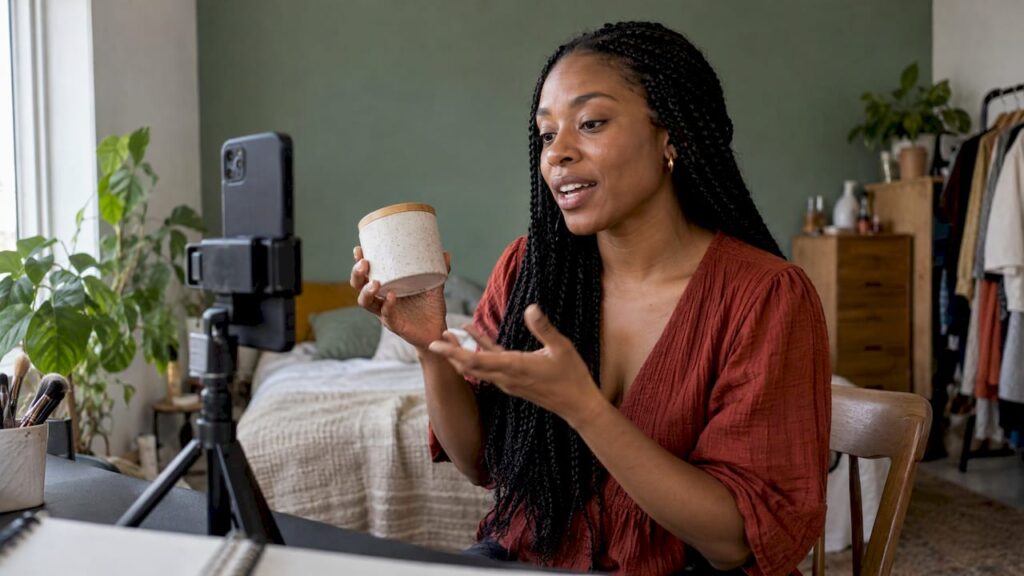
You can make money on Instagram in two ways: through Instagram’s own tools, or through income you build around your account. The second way pays more for most people. Brand deals, affiliate commissions and your own products need no minimum following, while Instagram’s built-in payouts are small and unlock at set follower counts. Below you’ll find what each method pays, what you need to qualify and how to get paid without breaking disclosure rules.
TL;DR
- Instagram pays almost nothing per view. Most creators earn $0 from views alone, so the money comes from brands, affiliate links, subscriptions, gifts and your own offers.
- Brand partnerships have no follower minimum. Affiliate tools, the Creator Marketplace and gifts open at roughly 500 to 1,000 followers, and subscriptions and badges at 10,000.
- Typical ranges: brand deals $75 to $7,500+ per post, affiliate $50 to $5,000+ per month. Nano accounts sit at the low end.
- Every paid or free-product post needs a clear disclosure in the first two lines of the caption.
- Pick one main stream first, prove it works, then add a second.
Table of Contents
- What Instagram actually pays for
- How many followers you need
- Method 1: Sponsored posts and brand deals
- Method 2: Affiliate marketing
- Method 3: Subscriptions, gifts and badges
- Method 4: Selling your own products and services
- Method 5: UGC and content licensing
- Instagram’s bonus programs
- A realistic income picture
- Get set up to be paid
- Disclose paid posts and affiliate links
- Our perspective
- Turn Instagram skills into remote work
- Common mistakes to avoid
- FAQ
- Sources
What Instagram actually pays for
Start with an honest picture. Instagram is a reach and proof-of-engagement platform. The checks mostly come from brands and buyers, not from Instagram. One 2026 analysis puts it plainly: there is no per-view program for most creators, the old Reels Play bonus ended in 2023, and the current bonus program is invite-only and time-limited.
A 2026 guide to monetizing Instagram lists 12 ways to earn. They fall into three buckets:
- Platform-native tools that pay you through Instagram: subscriptions, gifts, badges, bonuses.
- Brand partnerships that pay you directly: sponsored posts, affiliate commissions, content licensing, user-generated content (UGC).
- Independent income where you own the offer: digital products, coaching, consulting, merchandise.
The third bucket takes the longest to build and has the highest ceiling. The first has the lowest ceiling but the fastest start for accounts with a few hundred or thousand followers.
How many followers you need
The right question is which features you can use at your current size, not whether you have enough followers. Requirements shift, so check Instagram’s own help pages before you plan around a number. As of 2026, reported thresholds look like this:
| Way to earn | Typical follower threshold |
|---|---|
| Brand partnerships, UGC work | None |
| Gifts (Stars) on Reels | About 500 |
| Affiliate tagging, Creator Marketplace | About 1,000 |
| Subscriptions, live badges | 10,000 |
| Bonuses | Invitation only |
Sources for these figures: Digiday’s comparison of platform payouts puts fan tips at 500 followers, the Creator Marketplace and affiliate at 1,000, and exclusive content and livestream badges at 10,000. A tiered breakdown of eligibility agrees that brand partnerships are open regardless of follower count. It adds that every program requires a professional account, age 18 or older and original content.
One caution on Reels ad revenue. A 2026 guide to eligibility says ads on Reels require 10,000 followers plus 600,000 minutes viewed in 60 days. Thresholds for newer programs change often, so treat any number, including these, as a snapshot.


Method 1: Sponsored posts and brand deals
This is the core of Instagram income for most creators. A brand hires you, provides a creative brief and pays a flat fee based on your reach, engagement and follower count.
What the pay looks like depends on who you ask and how big the account is:
- Across all account sizes, a 2026 guide reports $75 to $7,500+ per post.
- For nano-influencers (1,000 to 10,000 followers), a 2026 guide citing an industry benchmark study says $10 to $100 per sponsored post is typical.
The gap between those numbers is the story. Small accounts often start with free product or modest fees, then raise rates as they collect results. Engagement rate, how the brand can reuse your content and whether you grant exclusivity all move your price. Pricing on those three factors helps you earn a fair rate at any size.
How to land your first deals
- Switch to a professional account and opt into the Creator Marketplace once you pass its threshold.
- Pick a narrow niche. Brands pay for an audience that matches their customer, not for raw numbers.
- Build a short media kit: your niche, audience location, average reach on Reels and Stories, engagement rate and two or three examples of your best content.
- Pitch small brands in your niche directly. Say what you’d make, for whom and what result you’d track.
- Agree on deliverables, usage rights, exclusivity and payment terms in writing before you post.
Method 2: Affiliate marketing
Affiliate marketing pays you a commission when someone buys through your link or code. Rates vary widely. Forbes puts typical commissions at 5% to 30% per sale, and the monthly range in one 2026 guide is $50 to $5,000+.
Instagram now has its own affiliate tool. According to Business Insider’s March 2026 report, eligible creators must be at least 18 with at least 1,000 followers. They can tag products from Meta’s brand catalog in Reels, up to 30 per reel. Each link must point to a single product, not a collection. Availability has rolled out in stages by country, so check whether it has reached your account.
Outside that tool, affiliate links usually live in your bio link, Stories or a link-in-bio page. Affiliate income works at any account size if your audience trusts you, because a small, loyal audience converts better than a large, passive one.
What converts
- Recommend things you use. Show them in a real situation, not a product shot.
- Match the product to a problem your audience already talks about in your comments.
- Say plainly that the link earns you a commission. That’s the law, and it also builds trust.
Method 3: Subscriptions, gifts and badges
These are the tools that pay you through Instagram itself.
- Subscriptions: fans pay monthly for exclusive content. A creator guide notes accounts with more than 10,000 followers can set prices from $0.99 to $99.99, and that creators keep 100% of subscription income minus taxes and service fees.
- Gifts: viewers buy Stars and send them on Reels. Forbes reports a payout of $0.01 per star, which means a $0.99 gift is worth about 99 Stars of value to the viewer, not to your wallet in a way that scales without volume.
- Badges: viewers buy badges during a live video. Guide figures put badges at $0.99 to $4.99 each.
Treat these as a bonus layer for an engaged audience, not as a main income. As Digiday’s Alyssa Mercante observes, monthly subscriptions can be lucrative if you build an engaged audience in a niche, and a viral Reel can bring gifts from viewers.
For subscriptions to work you need a reason to pay: a weekly live Q&A, a template library, behind-the-scenes process posts or early access to what you publish. Offer something you can deliver every week without burning out.
Method 4: Selling your own products and services
This is where the ceiling rises. Forbes lists e-books, courses, mentorships and consulting sessions as income streams, along with physical merchandise through Instagram Shopping or third-party platforms.
For most people who earn online with a skill, the simplest start is a service: social media management, content creation, editing, coaching on something you already do well. Instagram becomes your portfolio. Each post shows what you can do, and the bio link sends people to a booking page or an offer.
If you sell digital products, the bio link matters more than any single post. A walkthrough on selling from your Instagram bio covers how a mobile-first store page can turn profile visits into sales. Whatever tool you use, keep the path short: post, bio, one clear offer, checkout.
Video quality pays for itself
Reels are the main reach format, and polished vertical video lifts both brand deals and product sales. If you don’t want to edit yourself, professional Reels video editing can free your time for pitching and client work. Whether you edit or outsource, reuse each piece of footage across Reels, Stories and carousels.
Method 5: UGC and content licensing
You don’t need an audience to be paid for content. Brands pay UGC creators to make posts, photos and videos that the brand publishes on its own channels. Forbes lists UGC work for brands as a way to earn on Instagram, and one 2026 guide reports $150 to $2,000+ per asset for UGC and licensing.
This suits people who are better behind a camera than in front of it. Build three to five sample videos in different styles, then pitch brands. Your following matters less than your ability to make content that sells.
Instagram’s bonus programs
Instagram also runs invite-only bonuses. Shopify’s guide explains that invited creators are paid based on how their Reels, carousels and photos perform. Invitations go to creators 18 or older in eligible countries who meet minimum view counts, such as five million views in the last three months for Reels creators.
You can’t apply your way into a bonus. Make good, original content consistently, and treat any invitation as extra rather than as a plan.
A realistic income picture
Earnings concentrate at the top, as in any creator market. A reported analysis of creator payment data in 2025 found a median payment of $3,000 against an average of $11,400 in campaigns with direct payments. A small group takes most of the money. The practical lesson: your first goal isn’t a six-figure year. It’s your first paid deal, your first affiliate sale and your first product sold.
A sensible sequence for a new account:
- 0 to 1,000 followers: Define your niche, post consistently and make UGC samples. Pitch small brands for free product or modest fees.
- 1,000 to 10,000 followers: Turn on affiliate tagging and Creator Marketplace, price your posts and launch a small digital product or service.
- 10,000+ followers: Add subscriptions and badges for fans, and raise brand rates with proof of results.
Get set up to be paid
Payouts need paperwork. According to one monetization requirements guide, you need:
- A professional account.
- To be at least 18 and live in a supported country.
- To follow Instagram’s partner monetization and content monetization policies.
- Payout and tax onboarding: a legal identity matching your ID, a bank or PayPal account and tax forms (W-9 for U.S. creators, W-8BEN or a local equivalent for non-U.S. creators).
Digiday reports a U.S. payout minimum of $5, paid twice a month. Outside the U.S., the minimum is $100 for wire transfer and $25 for other methods.
For taxes on income you earn, talk to a tax professional in your country. Creator income is generally taxable, and brand fees and affiliate commissions are usually reported as self-employment income in the U.S.
Disclose paid posts and affiliate links
If you were paid, received free product or earn a commission, you must say so. The Paid Partnership label applies to any content where you received payment, free product or another benefit, and the disclosure has to be clear and hard to miss.
A summary of FTC guidance says disclosures should appear in the first two lines of the caption, before any links, so people see them without tapping “more.” Clear examples include #Ad, #Advertisement, #Sponsored and #BrandPartner. “Thank you,” #sp, #spon, #collab and “Ambassador” are not clear enough. In video, say it aloud and add a text overlay at the start.

For current rules, read the FTC’s endorsement guidance directly. It’s the final word, and brands will expect you to follow it.
Our perspective
We’ve read a lot of “make money on Instagram” advice, and most of it sells a feeling instead of a plan. Our view is simple: Instagram is a storefront and a portfolio, and the income comes from what you attach to it.
That’s why we pay attention to people building remote careers around social media. A creator who learns to manage accounts, write captions, edit Reels or report on analytics can earn from clients and employers long before they reach 10,000 followers. The same skills then make their own account stronger.
We don’t promise earning numbers. Pay ranges are wide, the top of the market takes most of the money, and anyone quoting a guaranteed monthly figure is guessing. What we can offer is practical analysis, honest comparisons and a place to find legitimate remote social media work while you build your own audience.
If you’re starting, pick one stream, learn it properly and keep a record of your results. Those results are what brands and employers pay for.
Yassine
Turn Instagram skills into remote work
Building your own account is one path. Another is to get paid for the same skills now. RemoteProfitly collects remote social media roles, guides and community resources for people who want flexible online work as managers, content creators or analysts. Browse what’s open on RemoteProfitly and use your Instagram results as your portfolio.


Our editorial approach is to avoid unrealistic earning promises and to be clear about how we make money, so you can judge any recommendation for yourself.
Common mistakes to avoid
- Chasing followers over fit. A small account with a clear niche often beats a large, scattered one for brand deals.
- Skipping disclosure. It risks your brand relationships as well as breaking FTC rules.
- Relying on one income stream. Algorithms and programs change. Pair brand deals with affiliate income or your own offer.
- Underpricing and no contract. Agree on usage rights and payment dates in writing.
- Posting without a destination. Every post should lead somewhere, whether that’s a bio link, a booking page or a product.
FAQ
Can I make money on Instagram with under 1,000 followers?
Yes. Brand partnerships have no follower minimum, and so does UGC work. Affiliate links in your bio and Stories also work at any size if your audience trusts you. Expect modest fees at first, often $10 to $100 per sponsored post for nano accounts.
Does Instagram pay you for views?
Not for most creators. Current analysis says Instagram pays $0 per view, with only an invite-only, time-limited bonus program. Your income comes from brands, affiliate commissions, subscriptions, gifts and your own offers.
How fast can I earn my first dollar?
There’s no fixed timeline. Affiliate sales and small brand deals can come within weeks if you pitch actively and your niche is clear. Platform tools like gifts need 500 followers and subscriptions need 10,000, so those take longer for most accounts.
Do I have to tell my followers about affiliate links?
Yes. Disclose any payment, free product or commission clearly, near the start of your caption and before any links. Use the Paid Partnership label where it applies.
Sources
- Hootsuite: how to monetize Instagram in 2026, 12 ways
- Forbes: how to make money on Instagram, 8 strategies
- Business Insider: Instagram and Facebook push deeper into shopping and affiliate marketing
- Buffer: make money on Instagram in 2026
- Creaticalc: what every platform pays creators per 1,000 views
- Digiday: how every major platform pays creators
- EmbedSocial: new Instagram features in 2026
- American Followers: Instagram monetization requirements 2026
- Epidemic Sound: content monetization guide
- Shopify: how to make money on Instagram
- Audiodrome: Instagram monetization requirements
- LTK: how US influencers keep content compliant with the FTC
- Creator economy analysis of CreatorIQ payment data
- Selling from your Instagram bio
- Professional Reels video editing