You're staring at a job post that says “social media analyst,” but half the bullets sound like a content manager, and the rest sound like a spreadsheet addict. That confusion is normal. Most candidates waste time applying to roles they can't actually do, or they undersell themselves because they think the job is just posting, pulling numbers, and sending a weekly recap.
A sharper focus is needed. A real social media analyst job description is about turning platform data into decisions, not just tracking vanity metrics. If you know how to read performance patterns, spot what content is working, and explain what the next move should be, you're already closer to the job than people who only know how to schedule posts.
Table of Contents
- What a Social Media Analyst Actually Does
- Core Responsibilities and Daily Duties
- Key Metrics and Tools Every Analyst Must Know
- How AI and Short-Form Video Are Reshaping the Role
- Salary Expectations and Career Progression
- Sample Job Description Language for Resumes and Postings
- Finding Remote Social Media Analyst Roles
What a Social Media Analyst Actually Does
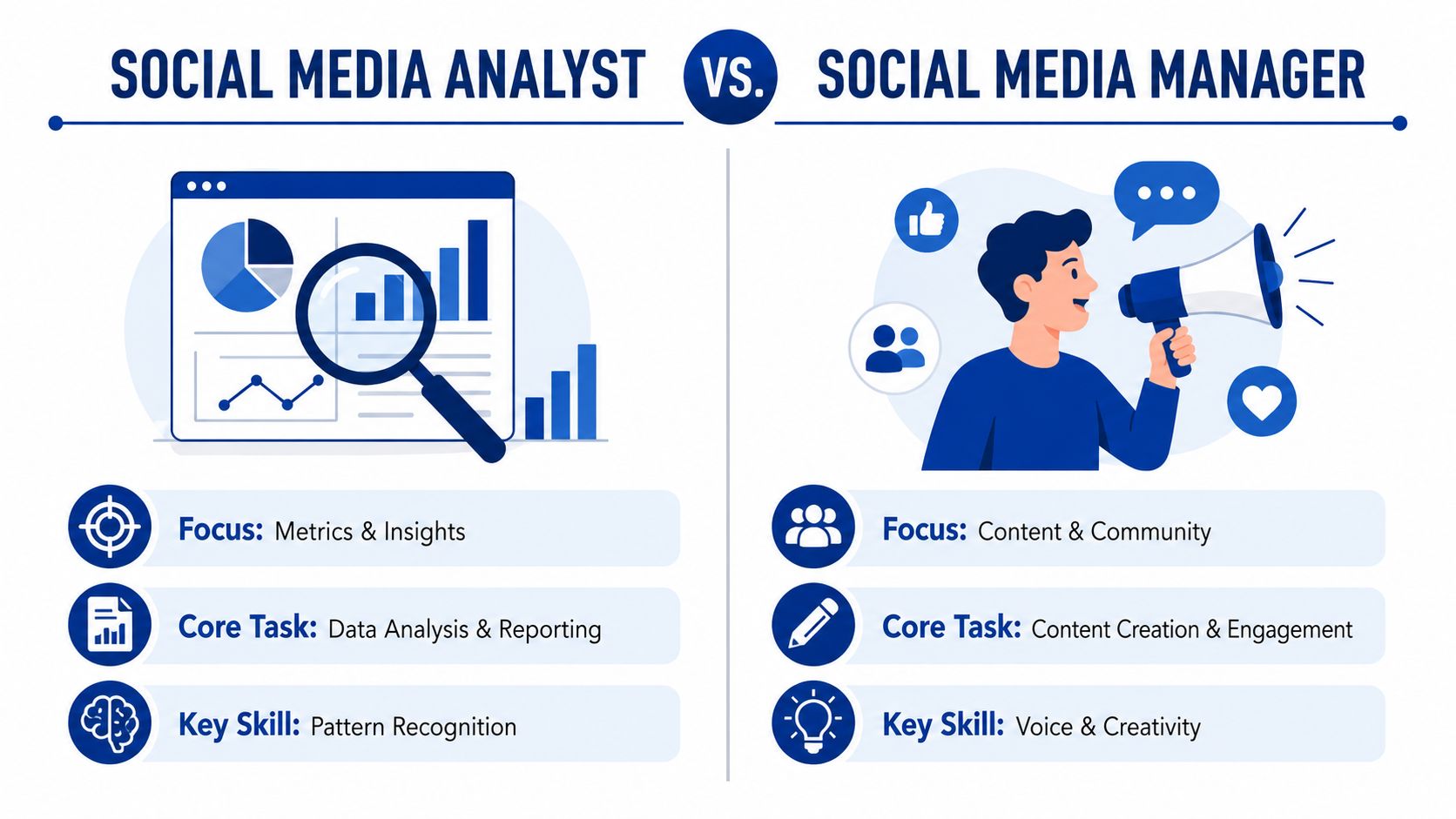
A candidate opens ten job postings and sees the same fuzzy language. “Manage social channels.” “Track performance.” “Support strategy.” That sounds broad because companies often blur the line between the analyst and the manager. Hiring teams don't blur it, though. They usually want the analyst to interpret data, build reports, and recommend what to do next, while the manager handles publishing, community management, and channel execution, as outlined in the job-family guidance from Upwork's social media analyst job description overview: Upwork's social media analyst job description.
Analyst versus manager
The analyst sits closer to the marketing intelligence side of the team. On a good day, that means reviewing engagement patterns, building dashboards, and turning social performance into a recommendation a marketing director can act on. On a bad day, it means being mistaken for the person who should reply to comments, write captions, and choose hashtags.
That distinction matters because companies hire analysts for business insight, not for content errands. If a posting emphasizes reports, dashboards, social listening, and stakeholder communication, you're looking at a real analyst role. If it emphasizes publishing cadence, inbox management, and audience engagement, that's a manager role wearing analyst clothes.
Practical rule: if the posting asks you to explain what changed in performance and why, it wants an analyst. If it asks you to keep the channel moving every day, it wants a manager.
What the deliverables actually look like
The output is usually a mix of reports, dashboards, and optimization recommendations. Some teams want a weekly performance summary. Others want a live dashboard that shows trends in engagement, impressions, click-through rates, follower growth, and conversion rates. The important part isn't the file format. It's whether your work helps the team decide what content to make next.
Many employers also expect a bachelor's degree in marketing, communications, data analytics, business, or IT, which tells you how specialized the role has become. That expectation shows up in the job-market guidance because brands now treat social performance as measurable business activity, not a side task attached to posting. If you want a second source for title and compensation context, compare salaries for social data analysts before you decide whether you're applying at the right level.
Core Responsibilities and Daily Duties
A strong analyst doesn't spend the day staring at one dashboard. They move between collection, interpretation, and communication. That's why hiring managers want someone who can work with messy platform data, connect it to business goals, and explain it without hiding behind jargon.
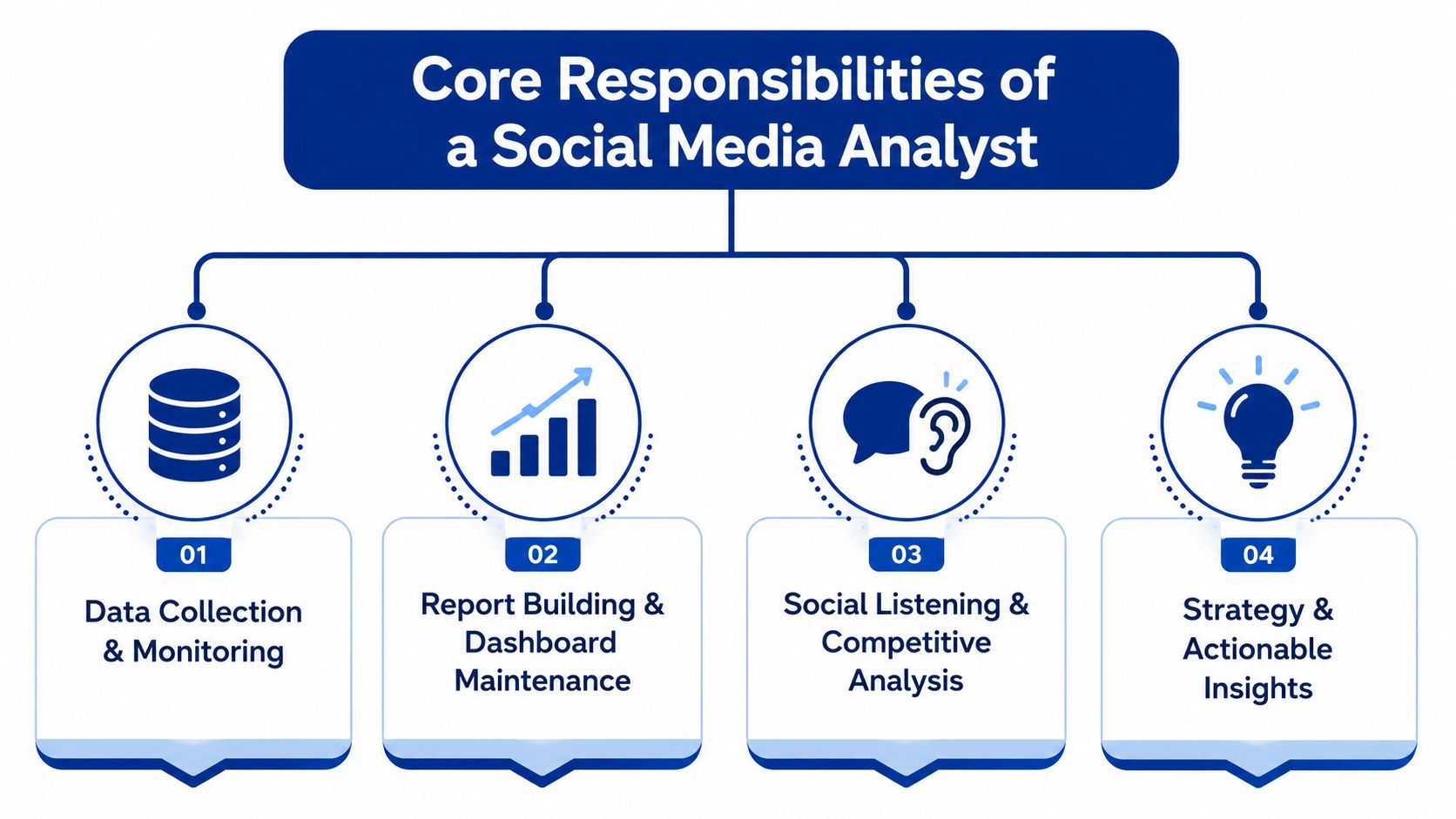
Data collection and monitoring
The morning often starts with checking native platform analytics, pulling data from Google Analytics, or verifying that a scheduled report captured the right timeframe. The point is not to collect numbers for their own sake. The point is to make sure the team is looking at clean performance data before anyone starts making decisions.
Some analysts also monitor social listening signals to catch emerging sentiment, a competitor move, or a topic spike before the content team misses it. That's where the role starts to look less like support and more like early warning systems for marketing. If you can flag an issue or opportunity before it becomes obvious, you're adding real value.
Report building and dashboard maintenance
Once the data is in, the analyst has to make it usable. That usually means updating a dashboard, formatting a weekly report, and highlighting what changed since the last cycle. The best reports don't overwhelm people with charts. They point directly to what needs attention.
A useful benchmark for team coordination is how well the analyst translates findings across functions. If your content team, marketing lead, and stakeholder group all leave the meeting with a clear next step, the report did its job. If they leave with more questions than answers, the data wasn't packaged well enough.
You can see how team workflow affects reporting rhythms in this internal guide on how social media teams collaborate.
Social listening and competitive analysis
Social listening is where an analyst stops reporting on owned channels and starts reading the wider conversation. That includes what customers are saying, what competitors are pushing, and where sentiment is drifting. The job gets more useful when you translate that into something concrete, like a content angle, a response plan, or a warning about a product issue.
When sentiment shifts, don't bury it in a spreadsheet. Put it in front of the people who can act on it.
Cross-functional collaboration
The analyst is only useful if the rest of the team can use the insight. That means regular collaboration with content creators, marketers, strategists, and leadership. The job is part analysis, part translation, part internal diplomacy.
The key test is whether you can turn social data into something that changes behavior. If a post format performs better, the content team should know. If a campaign is underperforming, the marketing lead should know. If a brand issue is brewing, stakeholders need to hear it fast.
Key Metrics and Tools Every Analyst Must Know
Hiring managers don't just look for “analytical mindset.” They scan for metric fluency and tool familiarity. If your resume can't name the platforms and measurements the team already uses, you'll look underprepared, even if you're smart enough to do the job.
Start with the workflow, not the software
The workflow usually starts with data collection. Native platform analytics matter because they're the first stop for post-level performance. Google Analytics matters when social traffic needs to connect to site behavior. Tools such as Hootsuite and Sprout Social matter because they help centralize monitoring and reporting.
From there, the analyst moves into visualization and dashboarding. Looker Studio, Tableau, and Power BI show up because teams want something they can read quickly, not a pile of raw exports. Once the story is visible, the analyst can explain where engagement is rising, where clicks are weak, and where conversion looks promising.
For a deeper walkthrough of reach and impression measurement, use this internal guide on how to measure post reach and impressions.
Metrics that actually matter
The metrics most job descriptions expect are engagement rates, impressions, click-through rates, follower growth, conversion rates, share of voice, and sentiment scores. Those numbers tell a team whether the audience is paying attention, taking action, and talking about the brand in a positive or negative way. The analyst's job is to connect those measurements to recommendations, not to recite them like a scoreboard.
A metric only matters if it changes the next decision. High impressions with weak clicks can mean the content is visible but not compelling. Strong engagement with poor conversions can mean the post entertained people but didn't move them toward action. That's the kind of judgment hiring managers want.
Tools by workflow stage
| Workflow Stage | Tool Examples | Primary Metrics Tracked |
|---|---|---|
| Data collection and monitoring | Native platform analytics, Google Analytics, Hootsuite, Sprout Social | Engagement rates, impressions, click-through rates, follower growth, conversion rates |
| Visualization and dashboarding | Looker Studio, Tableau, Power BI | Trend lines, campaign performance, cross-channel comparisons |
| Social listening and sentiment | Brandwatch, Mention, Meltwater | Share of voice, sentiment scores, topic spikes, competitive mentions |
What to learn next
If you already know one platform well, don't chase every tool at once. Learn the tools that map to the workflow your target employer already uses. A candidate who can explain how they move from data collection to dashboarding to insight delivery looks more hireable than one who lists ten platforms without context.
Hiring reality: tool names get you through the scan. The ability to explain what the numbers mean gets you the interview.
How AI and Short-Form Video Are Reshaping the Role
A lot of older career guides still describe the analyst as someone who pulls numbers, builds a report, and hands it off. That version is outdated. AI now speeds up parts of reporting and visualization, and short-form video has made content testing much faster and more chaotic.
What AI is taking over
Basic report generation and manual data pulls are getting commoditized. If a tool can compile a dashboard faster than you can open five tabs, that work stops being a differentiator. That doesn't make the analyst less important. It makes the analyst's judgment more important.
The value now sits in what happens after the data appears. Someone still has to decide whether a dip is a platform issue, a content issue, or a timing issue. Someone still has to explain whether a trend is worth testing again. AI can't own that call by itself.
Why short-form video changes the job
Short-form video creates more experiments, more formats, and more pressure to react quickly. Analysts are now expected to look at performance patterns across clips, hooks, captions, and posting windows, then advise the creative team on what to test next. That's a different job from sitting on last week's numbers and filing a report.
The skill that rises here is interpretation. A good analyst connects format choice, platform behavior, and audience response without pretending every result is permanent. They help content teams make faster decisions with less guesswork.
If you're trying to prove whether your work affects business outcomes, the right lens is calculate true social impact, not just counting outputs.
Skills that are getting more valuable
The most useful candidates now bring creative collaboration, experimentation, and cross-format analysis. They can speak to editors, designers, and marketers without getting trapped in reporting language. They also know when a dashboard is enough and when a test is needed.
The outdated candidate is the one who only knows how to export data. The stronger candidate knows how to use automation, then spends their time interpreting what automation can't explain. That's the shift.

Salary Expectations and Career Progression
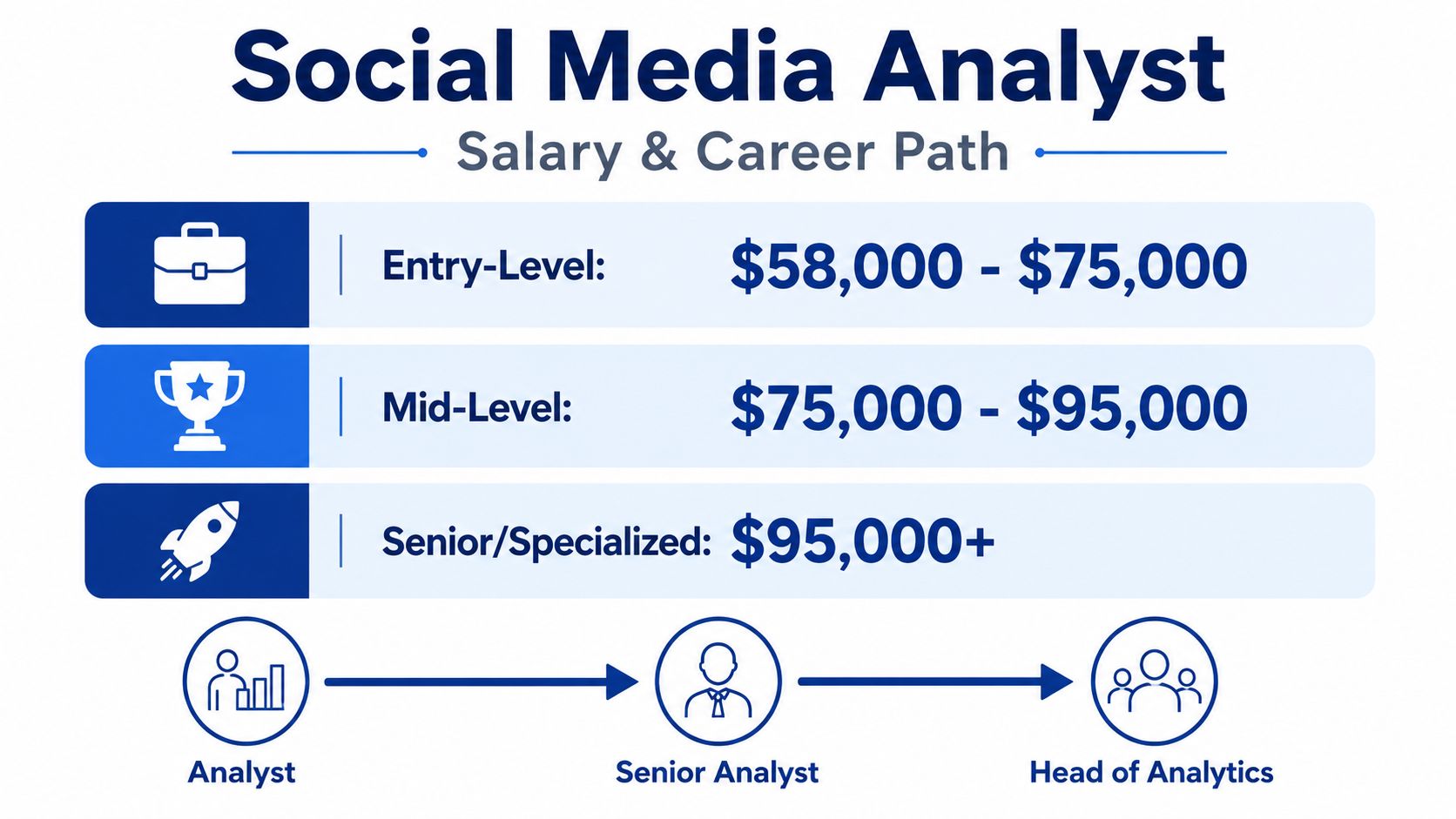
A social media analyst's pay is shaped by scope, not just title. A person who only pulls channel reports sits in a different pay band than someone who owns cross-channel analysis, presents to leadership, and tells the creative team what to test next. In the AI and short-form video era, hiring managers want decision support, not a spreadsheet translator.
What the available pay signals tell you
A job-description source places the Social Media Analyst/Manager salary range at $58,000 to $95,000 (JobDescription.org). A separate career resource reports an average salary of $44,261 for a social media specialist, which shows how much title and scope affect compensation. Another industry reference notes average base pay for a social media analyst at around $60,000 per year.
Those numbers point to the same reality. Compensation follows responsibility. If you own dashboards, executive reporting, and strategic recommendations, you are not doing the same work as someone who schedules posts and writes a basic recap. For candidates who want to present that kind of experience clearly, social media manager resume examples can help you frame the work in language hiring managers recognize.
Where the role usually leads
The usual next step is Social Media Manager, Social Media Director, or a move into marketing analytics, consumer insights, and digital strategy. That path makes sense because the analyst already sits close to performance data and cross-functional decisions. The job gets broader, not unrelated.
The strongest analysts also start to influence creative direction. They spot which hooks, captions, formats, and posting windows deserve another test, then bring that evidence into planning conversations. That mix is what separates a reporting role from a real career track.
What gets you to the next level
Promotion goes to people whose analysis changes what the team does. Better reports help. Better recommendations help more. If you can show that you understand audience behavior, content testing, and stakeholder priorities, you look ready for a bigger remit.
Hiring managers also watch for judgment. They want someone who knows when automation is enough and when a new test is needed, especially as AI tools handle more of the routine reporting. The analyst who can connect performance data to creative choices is the one who moves up.