
SettlePal is a legitimate AI-powered crypto arbitrage platform with a trust score from independent security reviewers and a domain history of several years. It scans global exchanges in real time, executes buy and sell trades in milliseconds, and routes profits back to your wallet in USDT within 24–72 hours after trade execution. For traders who want automated arbitrage without watching charts all day, the core proposition is genuinely appealing.
That said, this SettlePal crypto arbitrage review exists because the platform raises real questions worth answering before you commit funds. Here is what you need to know upfront:
- What it does well: AI-driven multi-exchange scanning, automated USDT stablecoin settlement, and a smooth user interface that new traders can navigate without a steep learning curve.
- What to watch: Withdrawals are not instant. The settlement window is 24–72 hours, which is a deliberate trade-off for secure routing, but it catches users off guard if they expect immediate access.
- Trust signals: Active SSL certificate, no malware or phishing flags from major security engines, and a Cloudflare-registered domain, hosted in the US.
- Fee sensitivity: Profitability on arbitrage trades is tightly tied to transaction and settlement costs. Thin margins can erode quickly if fees are not factored in before each trade.
- User feedback trend: Reviews on the platform’s own site describe a smooth experience and responsive support, though some users note that support resolution takes time.
The verdict: SettlePal is a credible platform for automated crypto arbitrage, but it suits a specific type of trader. Read on to decide if that trader is you. Join Thousands of Smart Traders. Put AI to work for you 24/7 while SettlePal scans global markets and executes opportunities automatically. Register Now and Start Your First Trading Cycle.
How does SettlePal work?
SettlePal’s entire model rests on one idea: price differences for the same cryptocurrency exist across global exchanges at any given moment, and those gaps close within seconds. The platform’s AI engine is built to find and act on those gaps faster than any manual trader can.
The four-step execution cycle
-
- You start a trade. You initiate a trade cycle from your account. No manual market monitoring required.
- AI scans the market. The system monitors multiple global exchanges simultaneously in real time, looking for pricing inefficiencies across trading pairs.
- Instant execution. When a spread appears, SettlePal executes two trades simultaneously, buying on the cheaper exchange and selling on the higher-priced one, all within milliseconds.
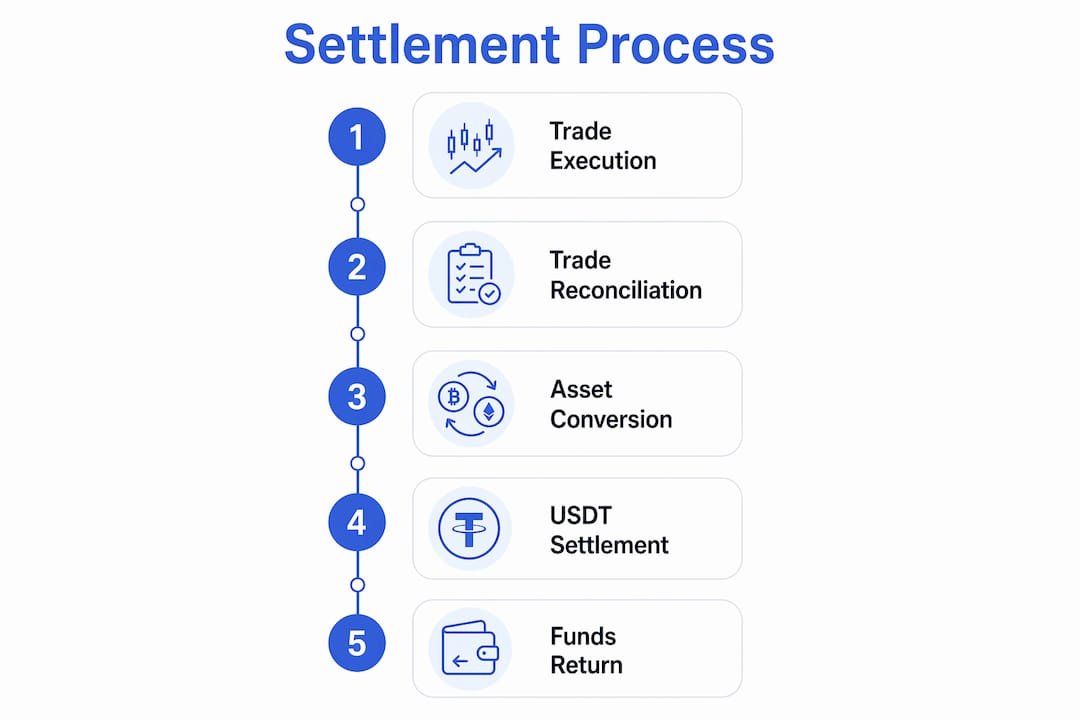
- Settlement to USDT. Profits are converted into USDT, consolidated, and routed back to your trading wallet. The settlement window runs 24–72 hours from execution.
- Start Your AI Trading Journey Today. Create your account, activate your first trading cycle, and let SettlePal’s intelligent system monitor global exchanges, identify trading opportunities, and execute trades automatically. 👉 Register Now and Get Started.
What happens during settlement
After execution, trades reconcile across exchanges, assets convert back into USDT, and funds return to your wallet ready for the next cycle. SettlePal uses controlled leverage during the execution window to accelerate settlement and maximise efficiency, then closes positions before the cycle ends. No third party is engaged beyond the active execution windows, which limits external exposure.
Pro Tip: Plan your liquidity around the settlement window of 24–72 hours. If you need access to funds within hours of a trade, SettlePal’s model will feel restrictive. Treat each cycle as a short-term commitment, not an instant transaction.
Key features at a glance
- AI arbitrage engine detecting price spreads across 10+ exchanges in real time
- Millisecond trade execution with no manual input required
- Automated USDT conversion and settlement routing
- Cross-border execution with intelligent routing to minimize exposure time
- Ready-for-next-trade cycle structure, so capital stays working
- Flexible execution accessible from any device
The platform’s end-to-end automation means you decide when to trade and the AI handles the optimization. No chart watching, no emotional decisions, just structured execution.

What does SettlePal pricing look like?
SettlePal’s specific fee schedule is not publicly listed in detail, which is a transparency gap worth noting. What the platform does make clear is the settlement structure and the role of USDT in its payout system.
Settlement and payout structure
| Component | Details |
|---|---|
| Settlement currency | USDT (Tether stablecoin) |
| Settlement window | 24–72 hours after trade execution |
| Withdrawal method | Routed to your USDT trading wallet |
| Exchange coverage | 10+ global exchanges |
| Leverage use | Controlled leverage during execution window only |
Why USDT for settlement?
USDT is a stablecoin pegged to the US dollar, which means your settlement value does not fluctuate between execution and payout. For cross-border payments and arbitrage, that stability matters. USDT-based settlement supports efficient payouts across regions without the volatility risk associated with settling in Bitcoin or Ethereum. For US-based traders, USDT also simplifies accounting since the value stays consistent in dollar terms.
Fee sensitivity and ROI
Profitability in crypto arbitrage is tightly tied to fees. Transaction costs, network fees, and settlement costs all eat into the spread you capture. Independent analysis of crypto arbitrage platforms consistently shows that platforms providing real-time net-profit calculation after all fees give traders a meaningful edge. SettlePal’s pricing details are not fully transparent publicly, so you should clarify the full fee structure directly with the platform before committing capital. Never assume the gross spread equals your net return.
Is SettlePal safe and trustworthy?
Security on a crypto platform breaks into two distinct categories: infrastructure safety and financial trustworthiness. SettlePal scores well on the first and requires more scrutiny on the second.
Infrastructure and domain safety
Independent security scanners give settlepal.com a trust score of 77/100, citing no major malware or phishing detections, a domain age of several years, and an active SSL certificate. A separate safety review scores the domain at 95 out of 100, noting it has never been connected to scams and maintains a positive reputation across security engines. The domain is registered through Cloudflare, Inc. and hosted in the US.
Security checklist
- SSL certificate: Active, TLS 1.3
- Malware/phishing flags: None detected by major security engines
- Domain age: 9.8 years (registered since approximately 2016)
- Blacklist status: Not blacklisted
- Hosting: US-based infrastructure
- Multi-language support: Yes
What the trust score does not tell you
A high domain safety score confirms the site is not a phishing trap. It does not confirm that the trading model is profitable, that the business is financially solvent, or that your returns are guaranteed. Security scanner scores reflect infrastructure reliability, not an audit of financial or operational risk. Due diligence beyond domain safety is essential before depositing funds.
Real user feedback
Reviews published on SettlePal’s own platform describe a generally positive experience. Users mention a smooth interface, fast transactions, and responsive support. One reviewer noted: “Withdrawals aren’t instant but they do arrive eventually without issues.” Another described the support team as helpful when resolving account limit questions, though resolution was not immediate. The consistent theme across feedback is that the platform works as described, with the settlement window being the main point of friction for new users.
Start Earning Today. Activate your trading cycle in minutes and let SettlePal’s AI identify and execute profitable opportunities automatically—no trading experience required. Click Here to Create Your Free Account.
Who should use SettlePal, and who should avoid it?
SettlePal fits a specific profile. Getting honest about whether you match that profile saves time and money.
Users who benefit most
- Passive income seekers in crypto: You want exposure to arbitrage returns without actively monitoring markets or executing trades manually.
- Businesses handling cross-border crypto payments: The USDT settlement model makes SettlePal practical for companies that need stable, predictable payouts across regions.
- Traders comfortable with short settlement delays: You can plan liquidity around a 24–72 hour window and do not need immediate access to funds after each cycle.
- Beginners to automated trading: The interface is described consistently as easy to navigate, and the four-step process requires no coding or technical setup.
- Users who prioritise stability over volatility: USDT settlement removes the risk of your payout losing value between execution and withdrawal.
Users who should look elsewhere
- Day traders needing instant liquidity: If your strategy depends on moving funds within hours of a trade, the settlement window creates a hard constraint.
- High-frequency manual traders: SettlePal is built for automation. Traders who want granular control over individual trade parameters will find the platform limiting.
- Users with very low fee tolerance: Thin arbitrage margins combined with undisclosed fee structures create uncertainty around net returns. If you need precise cost modeling before trading, the lack of a public fee schedule is a problem.
- Institutional investors requiring audited financials: The platform’s trust signals are infrastructure-based, not financial-audit-based. Institutions with compliance requirements need more than a domain safety score.
How does SettlePal compare to other crypto arbitrage platforms?
SettlePal sits in a specific niche: fully automated, AI-driven arbitrage with USDT settlement. Generic crypto arbitrage platforms cover a wide range of approaches, from manual signal tools to semi-automated scanners, but most lack SettlePal’s end-to-end automation or integrated stablecoin settlement.
| Feature | SettlePal | Generic crypto arbitrage platforms |
|---|---|---|
| Best for | Automated arbitrage with USDT payouts | Manual or semi-automated arbitrage trading |
| AI automation | Full end-to-end AI execution | Varies; often signals only, not execution |
| Settlement currency | USDT stablecoin | Varies; often native crypto |
| Settlement speed | 24–72 hours | Varies; often manual withdrawal |
| Exchange coverage | 10+ global exchanges | Ranges from 10 to 80+ depending on platform |
| Pricing transparency | Not fully public | Varies; some publish detailed fee schedules |
| Security score | 77–95/100 (independent reviewers) | Varies widely |
| User experience | Smooth, beginner-friendly | Ranges from complex to simple |
| Supported cryptocurrencies | USDT-settled; multi-pair scanning | Varies by platform |
| Cross-border execution | Built-in intelligent routing | Rarely integrated |
The clearest differentiator is automation depth. Most generic platforms give you the signals and leave execution to you. SettlePal handles detection, execution, and settlement in one automated cycle. That is genuinely useful if you want a hands-off approach, but it also means less visibility into individual trade decisions.
What are the best SettlePal alternatives for US traders?
If SettlePal’s settlement window or fee opacity does not fit your needs, several alternatives serve US-based arbitrage traders with different strengths.
- Arbi.TEAM: Scans 38 exchanges across 5,700+ coins, calculates net profit after all fees, and updates spreads every 3–7 seconds. It includes AI risk analysis on each spread and network validation to confirm deposit and withdrawal availability before you act. A good fit for traders who want to execute manually with full fee transparency.
- ArbitraDAR: Monitors price differences across 10+ exchanges with live updates every second, AI confidence predictions, and Telegram alerts. It offers manual trade reporting with CSV and PDF export for tax purposes, which matters for US traders managing capital gains reporting. Plans start free with a paid annual tier at $160/year.
- ArbitrageScanner.io: Covers 80+ CEX and 25+ DEX exchanges across 40+ blockchains. Particularly strong for futures and funding-rate arbitrage, which has largely replaced card-based P2P arbitrage. Pricing starts at $99/month for a test plan, with a VIP tier at $249/month or $2,999/year.
- P2P.Army: Tracks 9+ P2P exchanges and 120+ fiat currencies in real time, with a focus on funding-rate arbitrage across 17 futures exchanges. Every result is shown net of commission, so you only see spreads that pay after costs. Strong for traders who want data depth and multi-strategy coverage.
- Coinrule: A rule-based trading bot platform that lets you build automated strategies without coding. Less focused on pure arbitrage scanning and more on rule-driven execution across exchanges. A reasonable option if you want automation with more control over strategy logic.
Each of these tools requires more active involvement than SettlePal’s fully automated model. The trade-off is greater transparency and control over individual trades.
Is crypto arbitrage still profitable in 2026?
Crypto arbitrage remains a valid strategy in 2026, but the margins are narrower than they were in earlier market cycles. Market fragmentation across hundreds of centralised and decentralised exchanges still creates natural pricing gaps, and those gaps are the foundation of every arbitrage trade. The challenge is that fees, network speeds, and liquidity depth determine whether a visible spread actually translates into profit.
For serious arbitrage traders, real-time profit filtering after fees and network validations is the difference between a strategy that works and one that looks good on paper. Simplified models that show gross spreads without subtracting transfer fees, network gas, and settlement costs consistently yield lower returns than expected.
SettlePal’s millisecond execution addresses the speed side of this equation. The platform’s AI detects and acts on spreads before they close, which is the core technical requirement for profitable automated arbitrage. The open question for any user is whether the net return after SettlePal’s own fees justifies the capital commitment, and that requires direct clarification from the platform since the fee schedule is not publicly detailed.
Two trends are shaping the arbitrage space currently. First, AI-enabled platforms are raising the baseline speed requirement, meaning manual traders face an increasingly difficult environment. Second, stablecoin settlement is becoming the standard for cross-border arbitrage payouts because it eliminates the volatility risk between execution and withdrawal. SettlePal’s USDT model aligns with both trends.
What are the regulatory and legal considerations for US traders?
Crypto arbitrage is legal in the United States, but it carries real tax and compliance obligations that every trader needs to understand before starting.
The IRS treats cryptocurrency as property, which means every arbitrage trade is a taxable event. Each time you buy on one exchange and sell on another, you realise a capital gain or loss. Short-term gains, which apply to assets held under a year, are taxed at ordinary income rates. Keeping detailed records of every trade, including timestamps, amounts, and exchange rates, is not optional. Platforms like ArbitraDAR offer CSV and PDF export specifically to support this kind of tax reporting.
FinCEN regulations require US-based crypto businesses and, in some cases, active traders to comply with anti-money laundering rules. If you are trading at scale or operating a business that processes crypto payments, you may have money services business registration requirements. SettlePal’s cross-border settlement model means funds move across jurisdictions, which adds a layer of compliance complexity for US users.
State-level regulations vary. New York’s BitLicense framework, for example, imposes licensing requirements on crypto businesses operating in the state. If you are based in a state with active crypto regulation, verify whether your trading activity triggers any local licensing obligations.
The bottom line: consult a tax professional familiar with crypto before you start trading at any meaningful scale. The arbitrage profits are real, but so are the reporting requirements.
What are the hidden fees and total cost of using SettlePal?
SettlePal does not publish a detailed public fee schedule, which is the most significant transparency gap in this review. Here is what you can piece together from available information and what you should ask directly.
The platform uses controlled leverage during the execution window. Leverage typically carries a cost, whether in the form of interest, a spread markup, or a settlement fee. SettlePal’s website describes this as a tool to “accelerate settlement and maximise efficiency,” but does not quantify the cost to the user.
Settlement in USDT involves conversion from whatever assets were traded. Conversion fees, even small ones, compound across multiple trade cycles. On narrow arbitrage spreads, a 0.1% conversion fee can consume a meaningful portion of the gross profit.
Network fees for moving assets between exchanges are a standard cost in any arbitrage strategy. SettlePal’s automated routing handles this, but the cost is presumably embedded in the settlement calculation rather than shown as a line item.
Before depositing, ask SettlePal directly for answers to these three questions:
- What is the platform’s fee or commission per trade cycle?
- Are network and conversion fees deducted before or after the USDT settlement figure shown to users?
- Is there a minimum trade size or deposit requirement?
Clarity on these three points will let you model your actual net return rather than relying on gross spread estimates.
How do you set up and integrate SettlePal?
Setup on SettlePal follows a straightforward four-step process that does not require technical knowledge or API configuration.

Step 1: Register your account. The registration process is described by users as simple, with the support team available to guide you through any questions during onboarding.
Step 2: Fund your trading wallet. You deposit funds into your SettlePal account. The platform operates with USDT as the settlement currency, so having USDT available simplifies the process.
Step 3: Start a trade cycle. You initiate a trade from your account dashboard. From this point, the AI takes over: scanning exchanges, identifying spreads, and executing trades automatically.
Step 4: Receive settlement. After the 24–72-hour window, your profits are routed back to your wallet in USDT, ready to withdraw or reinvest in the next cycle.
There is no API key requirement for your personal exchange accounts, since SettlePal operates its own exchange infrastructure rather than connecting to your existing accounts. This is a meaningful distinction from scanner-based tools like ArbitrageScanner.io, which require you to execute trades yourself on your own exchange accounts. SettlePal handles the full execution cycle internally, which simplifies setup but also means you have less direct visibility into individual trade mechanics.
The platform is accessible from any device, with no desktop software installation required.
Unlock AI-Powered Crypto Arbitrage. Start your journey today and allow SettlePal’s advanced AI to monitor global exchanges and execute trades with speed and precision. Create Your Account Now.
Remoteprofitly can help you find the right online income path
Crypto arbitrage platforms like SettlePal offer one route to online income, but they are not the only one worth considering. If you are weighing whether automated trading fits your risk tolerance, time horizon, and financial goals, it helps to see the full picture of what is available.

Remoteprofitly is built for people who want to earn online without putting capital at risk. The platform connects you with legitimate remote income opportunities, including social media roles, content creation, and digital freelancing, backed by 50+ curated guides and resources. If you are exploring online income streams beyond crypto trading, Remoteprofitly gives you a structured, scam-free starting point. Over 100 people have found their footing through the platform in the past year, and the resources are designed to work whether you are just starting out or looking to diversify beyond a single income source.
Key Takeaways
SettlePal is a credible, AI-powered arbitrage platform with a 24–72 hour USDT settlement window, strong infrastructure safety scores, and a beginner-friendly interface, but its fee transparency gap requires direct clarification before committing capital.
| Point | Details |
|---|---|
| Trust score | Independent reviewers score settlepal.com at 77/100 to 95/100 for infrastructure safety. |
| Settlement window | Profits settle in USDT within 24–72 hours; instant withdrawals are not available. |
| Fee transparency | SettlePal does not publish a detailed public fee schedule; ask directly before depositing. |
| Best-fit user | Traders wanting fully automated arbitrage with stablecoin payouts and no manual execution. |
| Remoteprofitly | For income without capital risk, Remoteprofitly connects you with legitimate remote earning opportunities. |
FAQ
How does SettlePal work?
SettlePal’s AI scans 10+ global exchanges in real time, detects price spreads, and executes buy and sell trades simultaneously in milliseconds. Profits are converted to USDT and routed back to your wallet within a settlement window of 24–72 hours.
Is crypto arbitrage still profitable?
Crypto arbitrage remains viable in 2026, but margins are narrow and highly sensitive to transaction fees and network speeds. Platforms that calculate net profit after all fees in real time give traders the clearest picture of actual returns.
Is crypto arbitrage legitimate?
Yes, crypto arbitrage is a legal trading strategy in the United States. It is treated as a taxable event by the IRS, meaning every trade cycle generates a reportable capital gain or loss. Consult a tax professional before trading at scale.
What is the best crypto arbitrage platform?
The best platform depends on your trading style. SettlePal suits traders who want full automation with USDT settlement. Arbi.TEAM and ArbitraDAR are stronger choices for traders who prefer manual execution with detailed fee transparency. ArbitrageScanner.io leads for multi-strategy coverage across 80+ exchanges.
What are the main risks of using SettlePal?
The primary risks are the 24–72 hour liquidity lock during settlement, an undisclosed fee structure that makes net return modelling difficult, and the general caveat that infrastructure safety scores do not guarantee financial performance. Always verify fee details directly with the platform before depositing funds.
Recommended
- SettlePal Review (2026): AI Crypto Arbitrage Platform Explained + Real Earning Potential – Social Media Job Search Community
- Top 5 Rusticpathways.com alternatives 2026 – Social Media Job Search Community
- Passive Income Ideas That Actually Work in 2026 – Social Media Job Search Community
- Online Side Hustles That Pay Daily in 2026 – Social Media Job Search Community