

Getting your first freelance client is a skill, not a lottery. The fastest path to securing your initial freelance job is a specific service offer sent to people who already know you, not a polished website or a cold pitch to strangers. Freelancers who use warm network outreach land their first client in 3–8 weeks, compared to 8–16 weeks for those who rely on marketplace bidding alone. That gap is the difference between momentum and frustration. Remoteprofitly has guided over 100 freelancers through this exact process, and the playbook is consistent: start narrow, reach out early, and close professionally.
How to get your first freelance client with a focused service offer
The single biggest mistake new freelancers make is pitching everything they can do. Clients prefer specific, relevant offers that solve a named problem over broad descriptions like “I do marketing” or “I’m a writer.” Specificity reduces the mental work a client has to do, which speeds up their decision.
Start by translating your existing experience into a freelance offer. Internships, volunteer roles, and past jobs all count. A former customer service rep can offer “email response templates for e-commerce brands.” A marketing student can offer “Instagram content calendars for local restaurants.” The offer does not need to be original. It needs to be clear.

Build your offer around one sentence: who you help, what you do, and what outcome they get. For example: “I write weekly email newsletters for fitness coaches who want to grow their subscriber list.” That sentence is a pitch, a filter, and a positioning statement all at once.
Pricing your starter project correctly matters as much as the offer itself. Initial freelance projects typically range between $300 and $1,500 to prioritize building proof and momentum over maximizing profit. That range keeps the project accessible to small clients while still signaling that your work has real value.
- Define one specific deliverable (not a retainer or ongoing work)
- Set a clear timeline of two to four weeks
- Price 15–25% below market rate for your first client only, then return to full rates
- Write your offer in plain language, not industry jargon
- Avoid scope creep by listing what is not included
Pro Tip: Do not build a full website before your first client. A polished LinkedIn profile and one sample document are enough to start outreach today.
What are the best ways to find your first prospective clients?
Warm outreach is the most reliable method for finding your first freelance client. A warm contact is anyone who already knows your name: former colleagues, classmates, professors, neighbors, or people you have met at events. They do not need to be potential clients themselves. They need to know people who might be.
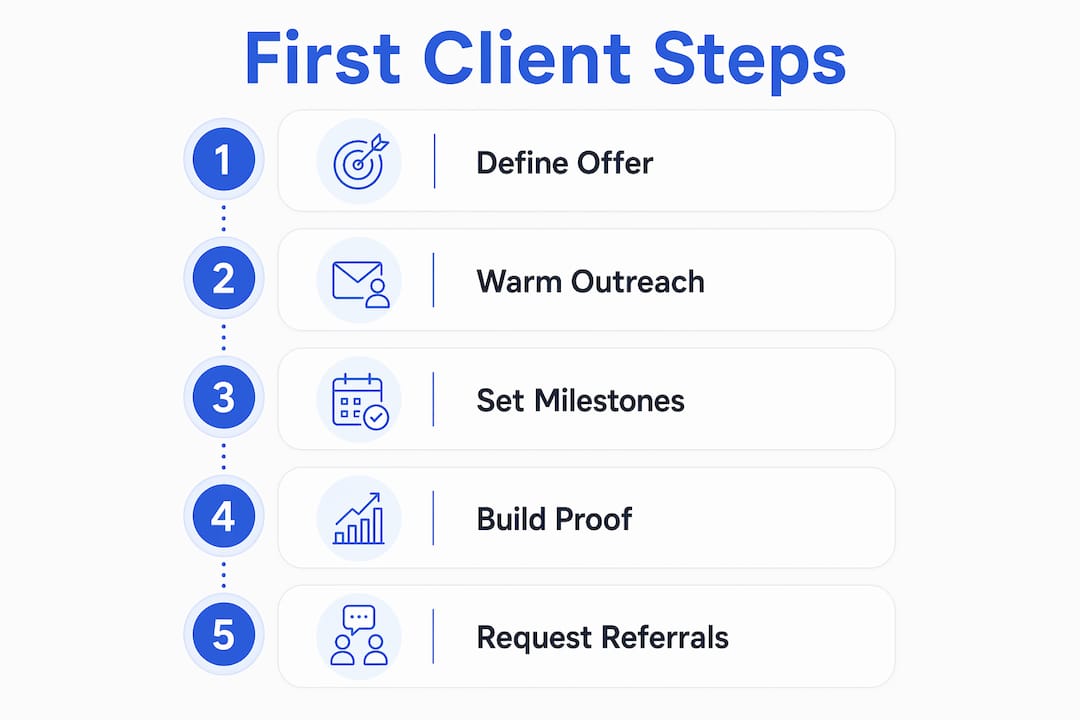
The 30-message rule is the most practical framework for this stage. Send 30 brief outreach messages to warm contacts within your first two weeks. Each message should be three to five sentences, mention what you now offer, and ask a low-pressure question. Expect actual client leads to emerge 4–11 weeks after your first messages go out. That lag is normal, not a sign of failure.
Here is a proven outreach sequence:
- List 30 warm contacts across LinkedIn, your phone, email, and social accounts.
- Write a short message that mentions your offer and asks if they know anyone who might need it.
- Follow up once after one week if you receive no reply. One follow-up is professional; two is pressure.
- Join two or three online communities in your niche (Slack groups, Reddit forums, Facebook groups for your industry) and contribute before pitching.
- Talk to local businesses in person. A coffee shop owner or a local gym may need exactly what you offer and has no idea freelancers exist for that work.
Pro Tip: Platforms like Upwork can build ratings over time, but they are not the fastest route for a first client without prior proof. Use warm outreach first, then add platforms once you have one case study.
For freelancers in digital roles, Remoteprofitly’s guide on direct outreach for social media roles breaks down message templates and timing in detail.
How do you close your first freelance deal professionally?
Converting a conversation into a paid project requires structure, not charm. The discovery call is where most new freelancers lose deals by talking too much. Listen 80% of the time during initial client conversations. Ask about the problem, the timeline, and what a good outcome looks like. Then propose a solution based on what you heard, not what you planned to say.
“The freelancer who asks the best questions wins the project. Clients remember the person who understood their problem, not the one who listed their skills.”
After a client says yes, send a concise Statement of Work within 24 hours. A professional SOW sent promptly sets a senior tone and reduces the risk of scope disputes later. Your SOW does not need to be a legal document. It needs four things:
- Scope: exactly what you will deliver
- Timeline: specific dates, not “about two weeks”
- Price: the total amount and payment schedule
- Revision policy: how many rounds of changes are included
Set payment milestones before you start any work. A 50% deposit upfront is standard for project-based freelance work. For guidance on structuring your rates and payment terms, the contractor pricing guide at Metrix Score covers common structures used by independent professionals.
Avoid unpaid trials entirely. If a client asks you to “do a quick test project” for free, offer a paid mini-project instead. Framing it as a low-risk paid engagement protects your time and signals that your work has value from day one.
How to build proof of work before and after your first client
You do not need a traditional portfolio to attract clients. You need proof that you can solve the problem you claim to solve. Spec work, personal projects, and audits all qualify. A social media manager can create a sample content calendar for a fictional brand. A copywriter can rewrite a real company’s homepage as a before-and-after exercise. These pieces demonstrate thinking, not just output.
After your first paid project, document it immediately. A short case study with three sections is enough: the problem the client had, the approach you took, and the result you delivered. This structure is the foundation of every strong freelance portfolio and the fastest way to attract your next client.
Referrals are the most underused growth tool at this stage. Ask your first client directly for an introduction to one other person who might benefit from your work. Explicit referral requests consistently outperform passive word-of-mouth. Most satisfied clients are happy to refer. They simply do not think to do it unless you ask.
| Proof type | When to use it | What it demonstrates |
|---|---|---|
| Spec work | Before first client | Creative thinking and execution |
| Past job reframe | Before first client | Relevant experience from prior roles |
| Paid project case study | After first client | Real results with a real client |
| Client testimonial | After first client | Trust and social proof |
| Referral introduction | After first client | Relationship quality and satisfaction |
The table above shows that proof-building starts before you have a single paying client. Do not wait for permission to create samples. The momentum you build in the first two weeks of outreach depends on having at least one piece of work to point to.
Key Takeaways
Warm outreach combined with a narrow, clearly priced service offer is the fastest and most reliable method for securing your first freelance client.
| Point | Details |
|---|---|
| Narrow your offer | Define one specific deliverable for one specific type of client before reaching out. |
| Use warm outreach first | Send 30 messages to existing contacts before turning to freelance platforms or cold email. |
| Price for momentum | Set your starter project between $300 and $1,500 and discount 15–25% for the first client only. |
| Close with a Statement of Work | Send a written SOW within 24 hours of a verbal yes to set professional expectations. |
| Build proof immediately | Write a short case study after every project and ask for a referral before the relationship cools. |
What warm outreach taught us about landing that first client
The Remoteprofitly Team has worked with hundreds of aspiring freelancers, and the pattern is consistent: the people who land clients fastest are not the most talented. They are the most specific and the most willing to reach out before they feel ready.
The conventional advice to “build your portfolio first” delays most beginners by months. A LinkedIn profile with one clear offer and 30 honest messages to warm contacts will outperform a polished website with no outreach every time. The portfolio comes after the first client, not before.
The mistake we see most often is treating the first client as a test of worth rather than a starting point. New freelancers either underprice dramatically (working for almost nothing “to get experience”) or overprice out of fear and then never send the proposal. The $300–$1,500 range exists precisely to avoid both traps. It is real money that signals real value, and it is accessible enough that small clients say yes.
Setting professional boundaries early also matters more than most guides admit. Clients who see a clear SOW, a deposit requirement, and a defined revision policy from day one treat the engagement differently. They show up prepared. They respect deadlines. The professionalism you model in the first 24 hours after a “yes” shapes the entire working relationship.
One more thing: persistence across 4–11 weeks of outreach is not stubbornness. It is the actual timeline. Most freelancers quit after two weeks of silence and conclude that outreach does not work. The data says otherwise. The leads are coming. Keep going.
— Remoteprofitly Team
Your next step toward a paid freelance career: Solid Gigs
How SolidGigs Helps Freelancers Land High-Paying Clients Fast
Finding high-paying clients is one of the most time-consuming challenges freelancers face. Scrolling through generic job boards, writing proposals for low-budget postings, and competing against hundreds of bidders can eat up hours every single week.
That is where SolidGigs comes in. SolidGigs is a job curation platform designed specifically for creative freelancers, copywriters, designers, and developers who want to skip the endless job search and pitch directly to high-quality clients.
What is SolidGigs?
SolidGigs is not a traditional freelance marketplace like Upwork or Fiverr. Instead of making you bid on low-cost gigs, SolidGigs acts as a lead generation service for independent professionals.
The platform utilises human lead hunters combined with AI tools to search dozens of web sources daily. It filters through thousands of active job listings to find the top 1% of freelance opportunities and delivers those vetted leads directly to your inbox.
Key Features and Benefits
1. Curated, High-Quality Job Leads
Instead of wasting time filtering out low-paying or scam listings, SolidGigs delivers hand-screened opportunities. Every lead includes direct links to apply directly at the source, allowing you to bypass third-party platforms.
2. 0% Commission Fees
Traditional freelance platforms often take a 10% to 20% cut of your hard-earned revenue. SolidGigs operates on a flat monthly membership model. You pay a predictable subscription fee and keep 100% of the money you earn from your clients.
3. Direct Client Relationships
Because you pitch directly to clients outside of a closed marketplace ecosystem, you retain full ownership of your client relationships, invoices, and project terms.
4. Educational Resources and Pitching Tools
SolidGigs offers more than just job alerts. Members gain access to a library of courses, masterclasses, and proposal templates designed to help freelancers convert leads into paying contracts.
Who Should Use SolidGigs?
SolidGigs is ideal for:
-
Established Freelancers looking to streamline their sales pipeline and save hours on lead generation.
-
Copywriters, Marketers, Designers, and Developers looking for mid-to-high budget projects.
-
Side-Hustlers who have limited time each week to pitch new clients.
Final Verdict
If you want to spend less time searching job boards and more time doing billable client work, SolidGigs ( Visit the website SolidGigs) offers a practical, high-ROI solution. By streamlining lead curation and eliminating commission fees, it helps freelancers scale their income and build a sustainable business.
SolidGigs is built for exactly where you are right now: ready to earn online but looking for the right starting point
FAQ
How long does it take to land your first freelance client?
Freelancers using warm network outreach typically land their first client within 3–8 weeks. Those relying on marketplace bidding alone often wait 8–16 weeks.
Do I need a portfolio before reaching out to clients?
No. Spec work, personal projects, or reframed past job experience all serve as proof of competence before you have a paid client. One strong sample is enough to start outreach.
What should I charge for my first freelance project?
Starter projects typically range between $300 and $1,500. Pricing 15–25% below your target market rate for the first client is a practical way to build trust and secure a case study.
What is a Statement of Work and why does it matter?
A Statement of Work is a short written document that defines the project scope, timeline, deliverables, and payment terms. Sending one within 24 hours of a client’s verbal agreement sets professional expectations and reduces disputes.
Should I use freelance platforms to find my first client?
Freelance platforms are useful for building ratings over time but are not the fastest route for a first client without prior proof. Warm outreach to existing contacts produces faster results at the beginning.
Recommended
- How to Become a Successful Freelance Social Media Manager – Social Media Job Search Community
- How to Land Freelance Social Media Marketing Gigs – Social Media Job Search Community
- Freelance Social Media Jobs: Start Your Career Today – Social Media Job Search Community
- Top 5 Best Online Income Streams for Beginners 2026 – Social Media Job Search Community